If you add up the ROAS each ad platform reports, you will often find they claim more revenue between them than your business actually made. Google says one number, Meta says another, and both are taking credit for the same orders. This is why a growing number of ecommerce brands judge their advertising on MER, the marketing efficiency ratio, instead of trusting platform-reported ROAS alone. Both numbers are useful. Knowing which one to trust for which decision is what keeps you from scaling a channel that only looks profitable.
What is MER?
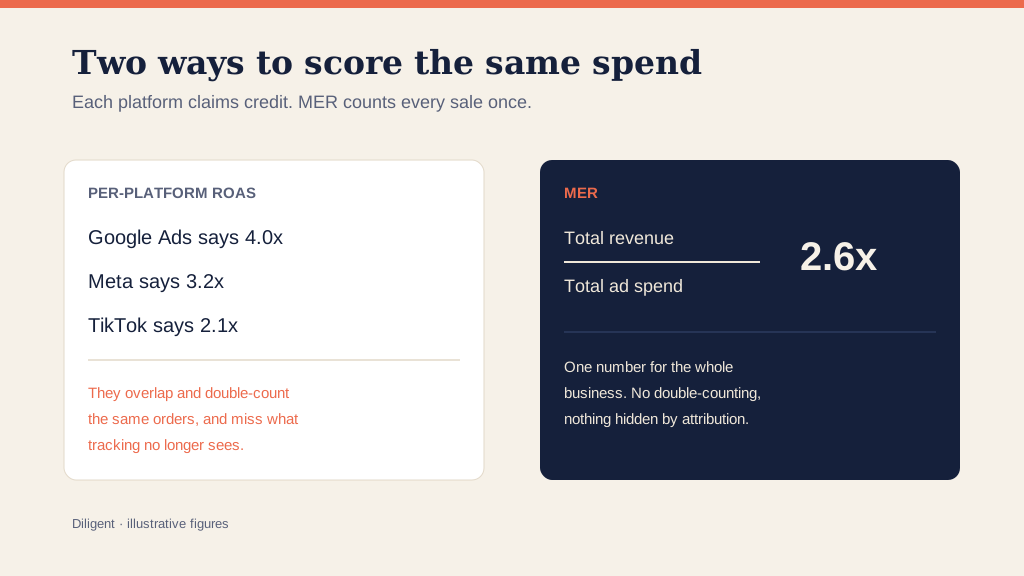
MER, the marketing efficiency ratio, is your total revenue divided by your total advertising spend across every channel, over a chosen period. If you did 260,000 in revenue and spent 100,000 on ads, your MER is 2.6x. It does not care which platform gets the credit or how attribution windows are set. It is the whole business looking at the whole spend, which is exactly why it is hard to fool. Some teams call the same idea blended ROAS; the maths is the same.
How to calculate and use MER
The calculation is deliberately crude, and that is its strength. Take total revenue for the period from the one source that cannot lie to you, your store's own backend or finance numbers, and divide it by total advertising spend across every platform, pulled from the platforms or your card statements. No attribution model, no conversion window, no platform's opinion about who deserves the credit. Just money in over money out.
Watch it on a steady cadence, weekly for most brands, against the same period last month and last year, and watch the trend more than the absolute level. A MER drifting down month over month while spend climbs is the earliest honest warning that you are scaling into less efficient demand, often long before any single platform's ROAS admits it. Because it is built from facts rather than attribution, MER is the one number a founder can trust without a tracking audit attached.
Why platform ROAS lies to you
Platform-reported ROAS is not dishonest on purpose, it is just structurally optimistic, for two reasons. First, every platform claims conversions it had any touch on, so when a shopper sees a Meta ad and later clicks a Google ad, both count the sale. Stack three or four platforms and the credit overlaps badly. Second, the figure is built on tracking that increasingly does not fire: privacy features and ad blockers hide a real share of conversions, which we cover in server-side conversion tracking. So platform ROAS manages to be both inflated by double-counting and undermined by missing data at the same time. MER sidesteps both, because total revenue and total spend are plain facts.
A worked example: when the platforms disagree with reality
Say Google reports a 4x ROAS, Meta a 3.2x, and TikTok a 2.1x on the same month's spend. Each looks healthy on its own dashboard, and a team reading them separately concludes every channel is paying. Then you calculate MER from the backend and find the whole business returned 2.6x on total ad spend. The platforms, added up, implied far more revenue than the business actually booked, because they each counted the same shoppers who saw more than one ad before buying. The gap between the sum of the platform stories and the single MER number is the double-counting made visible.
This is the moment that converts most founders to watching MER. It is not that the platform numbers are useless; it is that you cannot add them up, and read separately they let every channel look like a winner while the blended truth says the account is barely clearing its margin. MER is the reconciliation the platforms will never volunteer.
What is a good MER?
Like ROAS, there is no universal good MER, because the number that means profit for you is set by your margins. The same break-even logic applies: a brand on a 30% gross margin needs its blended return well above roughly 3.3x to cover product and ads and still profit, while a high-margin brand can grow happily at a lower MER. Work out your break-even from your margins first, exactly as we lay out in what counts as a good ROAS, then set a target MER above it with the profit you actually want baked in. The benchmark you see other brands quote is meaningless until it is anchored to a margin, and theirs is almost never yours.
The sharper version: new-customer MER
Plain MER has a blind spot of its own for any brand with repeat purchases: it mixes revenue from new customers with revenue from people you already had, so a healthy MER can hide whether the advertising is actually acquiring anyone. If returning customers keep buying, total revenue stays high and MER looks fine, even as the ads slowly stop bringing in fresh demand. A brand can coast on its existing base for months while its acquisition engine stalls, and blended MER will not tell it.
The fix is to divide new-customer revenue by total ad spend instead of total revenue by total spend. Some teams call this acquisition MER or new-customer MER. It is harder to compute, because you need clean new-versus-returning data, but it answers the question plain MER dodges: is the spend buying growth, or just re-touching buyers who would have come back anyway? This is the same incrementality instinct behind the new-customer goal in Performance Max and the non-brand prospecting discipline, where the job is to fund the demand you create, not the demand you already own.
MER while you scale: the number that catches over-claiming
MER earns its keep most when you are growing. Add a new channel, and platform ROAS will usually flatter you: the new platform claims conversions that were already coming, and your existing platforms keep their numbers, so the dashboards all look fine even if the new spend added little incremental revenue. MER is where that shows up honestly. If total revenue does not move in proportion to the extra spend, your MER falls, and it falls regardless of how good each platform's individual report looks. Watching MER through a scaling push is the cleanest way to catch a channel that is re-counting demand rather than creating it, which is the same incrementality question we ask of Performance Max and of brand campaigns.
MER and the limits of attribution
It is worth being clear about why MER stays useful even if your tracking were flawless. Attribution is always a model, a set of rules deciding which touchpoint gets the credit, and every model is a choice you could reasonably make differently. Last-click hands everything to the final ad; data-driven attribution spreads it; view-through credit inflates the upper funnel. Reasonable people argue about which model is right, and they are all, in the end, opinions about how to divide a sale that the customer experienced as one decision.
MER is the one number that sits outside that argument. Total revenue over total spend does not care which model you prefer, because it never tries to divide the credit in the first place. That is exactly why a founder can trust it without auditing anyone's attribution settings, and why it is the right scoreboard for the question that actually matters: is the advertising, all of it together, making the business money. The platforms will always have an opinion about who deserves the credit. MER is the fact underneath the opinions.
What MER gets right, and its blind spot
MER's strength is that it tells you the truth about the business: are you making money on your advertising as a whole, this month, against last. It is the number a founder should watch. Its blind spot is that it cannot tell you which campaign, channel or keyword to change. A MER of 2.6x does not say whether your non-brand Search is carrying the account or bleeding it, because it blends everything together. Used alone, MER tells you the ship is sailing but not which sail is doing the work. It is also blind to things outside advertising that move revenue, a viral moment, a price change, a seasonal swing, so a MER read in isolation can credit or blame the ads for something they did not do.
Use both: MER for the business, ROAS for the lever
The answer is not to pick one. It is to use each for what it is good at. Watch MER as the top-line scoreboard, the honest read on whether advertising is growing the business profitably. Then use platform-level and campaign-level ROAS as the steering wheel, to decide where to push and where to pull back, while knowing those numbers run rich and need clean tracking underneath them. This is the same discipline behind value-based bidding and what a good ROAS actually means: set the target against your real margins, trust the measurement, and judge the whole account by what reaches the bank. Getting that measurement right end to end is the heart of our web analytics and conversion tracking work, because even the ROAS you use as a steering wheel is only as honest as the tracking beneath it.
A weekly operating rhythm
Here is how the two numbers work together in practice, rather than in theory. Start the week with MER: is the business profitable on advertising, and which way is the trend running against last month and last year? That one read tells you whether you are playing offense or defense. If MER is healthy and you want growth, turn to campaign and channel ROAS to decide where to push, expanding the winners that still clear your margin. If MER is slipping, use the same campaign ROAS to find what to cut, starting with the non-brand and prospecting lines that are easiest to misjudge.
Through any scaling push, watch new-customer MER, because that is where over-claiming shows up first. And once a month, reconcile the tracking, because the campaign ROAS you use as a steering wheel is only as honest as the measurement beneath it, which is the thread running through all of our conversion tracking work. MER keeps you honest about the destination; ROAS tells you which road to take; clean tracking is what keeps the map from lying. Used in that order, you rarely get surprised by a channel that looked profitable on its own dashboard and was costing you money.
Frequently asked questions
Is MER the same as blended ROAS? Yes, the two terms describe the same calculation: total revenue divided by total advertising spend across all channels. Some teams prefer "blended ROAS" to make the contrast with platform ROAS explicit, but the maths is identical.
Should I replace ROAS with MER? No. MER is the business scoreboard and platform or campaign ROAS is the steering wheel. MER tells you whether advertising is profitable overall; ROAS tells you which lever to pull. Drop either and you are half-blind.
Why is the sum of my platform ROAS higher than my real return? Because the platforms each claim conversions they touched, so a shopper who saw two ads before buying is counted twice. You cannot add platform ROAS figures together. MER, built from total revenue and total spend, counts every sale once.
What is a good MER for ecommerce? Whatever clears your break-even with profit to spare, which is set by your gross margin, not a benchmark. Calculate break-even as one divided by your margin, then target a MER above it.
How often should I check MER? Weekly for most brands, read as a trend against last month and last year rather than a single day's figure. Daily MER is too noisy to act on; the monthly trend is where the honest signal lives.
Can MER tell me which channel to cut? No, and that is its one real weakness. MER blends everything, so it tells you the account is slipping but not which campaign is responsible. That is the job of campaign-level ROAS, which is why you run both rather than choosing.
The short version
- MER is total revenue divided by total ad spend. It measures the whole business and is hard to fool.
- Platform ROAS double-counts across channels and rides on tracking that increasingly misses conversions, so the sum of platform ROAS usually overstates reality.
- MER cannot tell you which campaign to fix; ROAS can, but only with clean tracking under it.
- Watch MER as the scoreboard, use ROAS as the steering wheel, and trust neither without honest measurement.