
Blended ROAS hides who is really working.
A healthy-looking blended ROAS is one of the easiest ways for an account to lie to its owner. When brand and non-brand sit in the same number, the brand campaigns (people searching for you by name, ready to buy) carry the average. The non-brand campaigns (people describing a problem, not a company) can sit underwater and nobody notices until growth stalls.
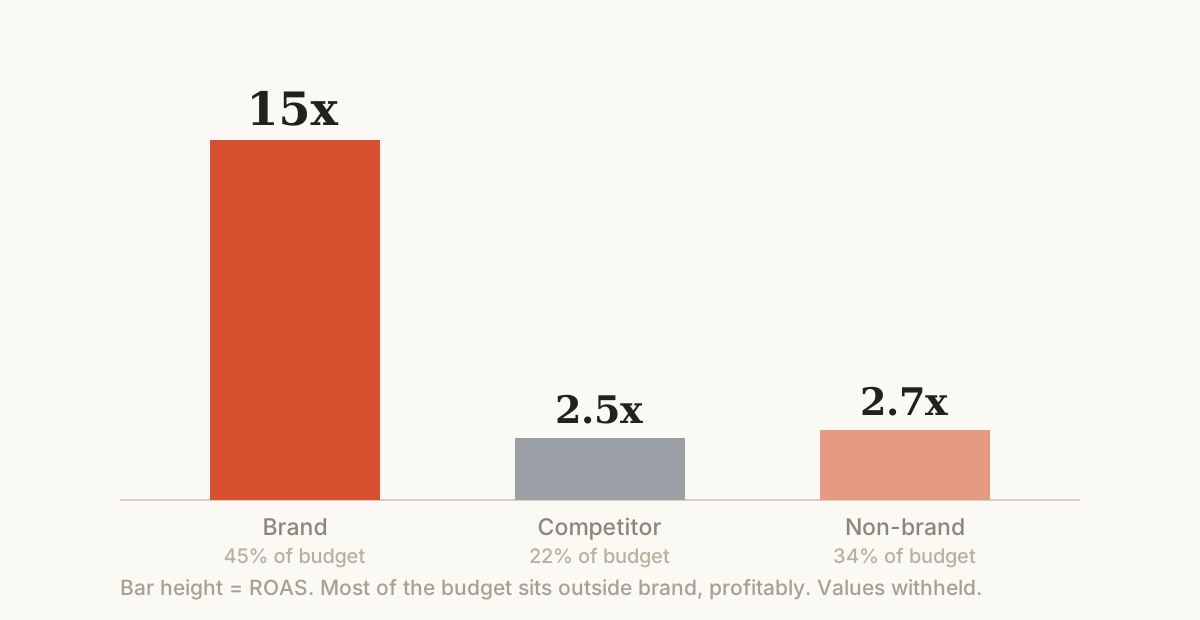
On one large mattress and bedding account, brand Search runs at roughly 15x ROAS. If you only looked at the blended number, you would assume the entire account was that efficient. It is not, and it should not be: the only way to grow beyond the demand you already have is to spend into non-brand, where ROAS is structurally lower.
Here is the trap that follows. A founder sees the blended ROAS, decides the account is healthy, then panics the first time someone shows them that non-brand alone runs at a fraction of it. The instinct is to cut non-brand and "keep the efficient part." But the efficient part is just demand you already earned. Cut non-brand and you stop growing; you keep harvesting the brand demand until it plateaus. The job is simpler than that: make non-brand pay on its own terms.
Separate the demand you capture from the demand you create.
The foundation is structural: brand, non-brand and competitor terms live in separate campaigns, each with its own budget and its own target. That separation is what lets us hold brand at its natural high ROAS while spending into non-brand at a target that still makes money, instead of letting one average smother the other. It also stops brand and non-brand from eating each other's budget inside a single shared pot.
From there, non-brand is built by intent. Broad category terms, specific problem and product terms, and review or comparison terms each behave differently and earn different targets. We group them so the algorithm is never asked to value a tire-kicker query the same as a high-intent one. A "best [category]" search and a "[specific product] reviews" search are at completely different points in the buying journey, and lumping them together blunts the bidding for both.
Disciplined Google Ads management leans on this: the structure does the heavy lifting before bidding ever gets involved. Get the segmentation right and Smart Bidding has clean, coherent groups to optimize. Get it wrong and no bidding strategy can rescue a campaign that mixes ready-to-buy and just-looking in the same bucket.
- Split brand, non-brand and competitor
- Group non-brand by intent
- Set a profitable target per group
What makes prospecting profitable.
Two accounts show the method from opposite ends. One is a sleep-category account that runs entirely on non-brand and review intent, with no brand equity to lean on at all. The other is a large mattress brand where non-brand is a deliberate, sizeable share of a much bigger budget.
a Prove non-brand can stand alone
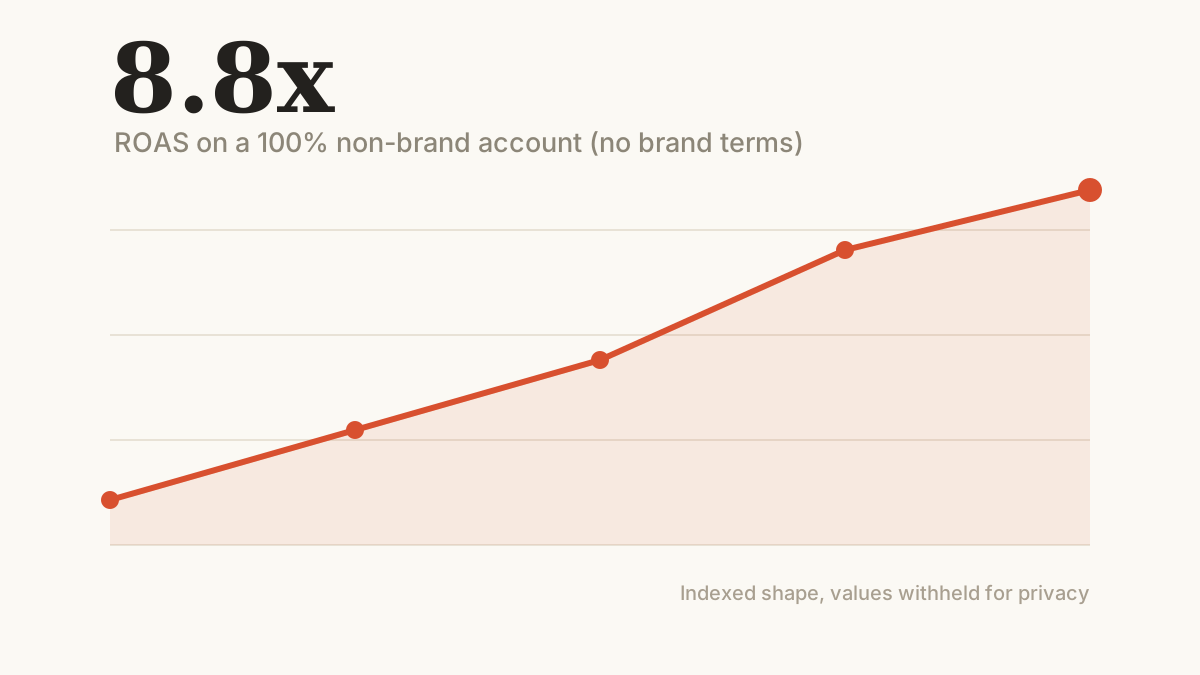
The sleep-category account is the clean proof. Every campaign is prospecting: category terms like best-in-class product searches, plus review and comparison intent. There is no brand campaign propping up the average, and it still runs at 8.8x blended ROAS.
Within it, the structure tells the story. Broad category terms hold a solid mid-single-digit ROAS and bring the volume; sharper review and comparison terms run far higher because the intent is closer to purchase. The account works because those two jobs are kept separate and funded differently, not because of one magic keyword. Here, non-brand carries the whole business on its own.
With the right intent and structure, non-brand alone can run at a ROAS most accounts only see on brand.
b Fund growth beyond brand at scale
On the large account, more than half of Search budget sits outside brand: roughly a third in pure non-brand prospecting at about 2.7x ROAS, and another fifth in competitor and conquest terms at about 2.5x. Both clear the account's margin. That is the discipline: holding brand at 15x while still pushing most of the budget into the harder, lower-ROAS terms that expand the customer base.
Most accounts get this backwards. They let brand balloon to flatter the blended number and starve non-brand to protect the average. We do the opposite: brand is capped at the coverage it needs, and the freed budget goes into non-brand at a target that still makes money. A 2.7x non-brand campaign that brings new customers is worth more to the business than another dollar poured into a 15x brand term that would have converted anyway.
A mature account does not hide behind brand. It funds real growth on non-brand and keeps it profitable.
c Let losing queries fund the negatives
Non-brand stays profitable only if it is groomed. Search-term review is continuous: the queries that spend without converting become the negative-keyword list that protects next month's budget. Here, poor data is not wasted; the queries that flop are the raw material for your exclusions.
This is the grind that keeps a prospecting account from leaking into irrelevant traffic. Broad and phrase match will always pull in queries you never intended, and left ungroomed, those queries are where a non-brand budget dies. A disciplined weekly negative-keyword habit is the difference between non-brand that compounds and non-brand that bleeds.
Non-brand that grows the business and still pays.
The proof sits at both ends of the scale. A 100% non-brand account at 8.8x ROAS shows prospecting can carry an entire business. A large account keeping more than 50% of budget outside brand, profitably, shows the same discipline holds at scale.
The lesson is the same either way: judge prospecting against a profitable non-brand target, not against your brand ROAS. The brand number is a comfort blanket. The non-brand number is the growth.
- Growth lives in non-brand. The work is making it pay on its own target, not pretending it should match brand.
Reading your own account honestly.
Start by splitting your reporting: what is your ROAS on brand alone, and on everything else? If the two are close, you are probably not spending enough into non-brand to grow, and you are more exposed than you think to a competitor moving on your brand. If non-brand is deeply unprofitable, the problem is usually structure (mixed intent in one campaign) or measurement, not the channel itself.
Set a non-brand target that reflects reality. Non-brand should clear your margin, not match your brand ROAS. A non-brand campaign at 2.5x to 3x that brings genuinely new customers can be one of the best investments in the account, even though it will never look as pretty as brand in a blended report.
Then groom it relentlessly with negatives. The accounts that win on prospecting do not have a magic keyword. They treat search-term review as a weekly habit and let the losing queries pay for next month's exclusions.
Where non-brand leaks.
Match-type creep is the first leak. Broad and phrase match are how non-brand finds new demand, but also how it wanders into junk queries. We watch the search-terms report like a hawk, because the gap between a groomed campaign and an ungroomed one is mostly the negatives someone added, or forgot to add, last week.
The second is the wrong benchmark. The fastest way to kill a healthy prospecting campaign is to judge it against your brand ROAS and cut it for "underperforming." We set the non-brand target from margin, and we hold the line when someone points at the brand campaign and asks why non-brand cannot do the same.
Then there is attribution. Under last-click, a non-brand click that first introduces someone to you, who then searches your brand and buys, hands all the credit to brand and makes non-brand look worse than it is. We keep an eye on assisted conversions and the brand-versus-non-brand interplay, so prospecting is not punished for doing its job upstream.
Last, scaling too fast. A non-brand campaign that just turned profitable is fragile: triple its budget overnight and it gets pushed into thinner, more expensive queries, and the ROAS collapses. We scale into proven non-brand in steps, expanding the winning intent groups rather than flooding the whole campaign at once.
Building non-brand by intent.
The phrase "group by intent" deserves more than a bullet, because it is the part that makes non-brand pay. We think of non-brand as a ladder, from people barely aware they have a problem up to people one click from buying, and each rung behaves so differently that mixing them in one campaign blunts the bidding for all of them.
Broad category terms sit at the bottom of the ladder. Searches like "best [category]" carry high volume and the lowest non-brand ROAS, but they are the discovery engine: this is where genuinely new customers enter. We fund them at a target that clears margin and accept that their job is reach, not efficiency.
Specific problem and product terms sit higher. The searcher has named what they want, so intent is stronger and ROAS is better. These get their own groups with ad copy that mirrors the exact need, because a generic category ad wastes the sharper intent.
Review and comparison terms sit highest of all, just below brand. Someone searching "[product] reviews" or "[product A] vs [product B]" is deep in research and close to a decision, which is why these terms can run at multiples of the category ROAS. They deserve dedicated campaigns, tailored copy, and landing pages built to answer the comparison.
The separation is enforced with negatives, so a high-intent query never serves from the broad category group at the wrong bid, and brand searches never leak in to flatter the numbers. Group the ladder properly and Smart Bidding has clean, coherent buckets to optimize; lump it together and no bid strategy can rescue a campaign that values a tire-kicker and a ready buyer the same. The same grooming discipline from the wasted-spend playbook is what keeps each rung clean.
What to remember.
Brand ROAS is not a skill, it is demand you already earned. The real measure of an account is whether non-brand pays.
Separate it, group it by intent, give it a profitable target, and groom it with negatives, and prospecting becomes the engine of growth instead of the line item everyone wants to cut. Done right, non-brand can run at 8x on its own, or take more than half a large account's budget and still clear the margin.
- A 100% non-brand account run at 8.8x ROAS, with no brand terms at all
- More than 50% of a large account's budget kept profitable outside brand
- Non-brand prospecting held at 2.7x alongside 15x brand
- Continuous search-term review turning wasted spend into protective negatives