
Your competitors are bidding on your name.
When someone searches your brand name, they are the most valuable searcher you will ever get: they already know you, they are usually close to buying, and they convert at far higher rates than any cold prospect, often two to three times higher. That is exactly why competitors bid on your brand terms. It is legal in most markets to bid on a rival's name as a keyword, and for a competitor it is a cheap way to put their ad in front of your most ready-to-buy audience.
If you do not defend your brand, that traffic leaks. Industry estimates put the share of branded impressions a competitor can capture anywhere from 15% to 40% when a brand leaves the door open. Every one of those is a customer who searched for you and was handed a competitor's offer at the top of the page.
The objection we hear is that brand spend is wasteful, because "those people would have found us anyway." Sometimes, on an undefended page with no competitors, that is partly true. The moment a competitor shows up on your name, it stops being true, and the cost of finding out the hard way is your best customers clicking someone else's ad.
Own your name, then take theirs.
Brand defense has two halves. The first is owning your own name: a dedicated brand campaign that holds near-total impression share on your terms, so a searcher looking for you sees you first and a competitor cannot cheaply outrank you. Because brand intent converts so well, this runs at a very high ROAS, which makes it some of the most efficient spend in the entire account.
The second half is conquest: bidding on competitors' terms in turn, defensively and selectively. It runs at a much lower ROAS than your own brand, because you are the underdog on someone else's name, but held at a sensible target it both wins incremental customers and signals that skimming your brand will not go unanswered.
Both halves are about protecting and extending the most efficient demand in the account. It is the same structural discipline as our Google Ads management: brand, conquest and non-brand kept in separate campaigns with separate targets, so each can be defended or scaled on its own terms.
- Hold near-total brand impression share
- Conquest competitor terms, selectively
- Keep each on its own target
What disciplined brand defense looks like.
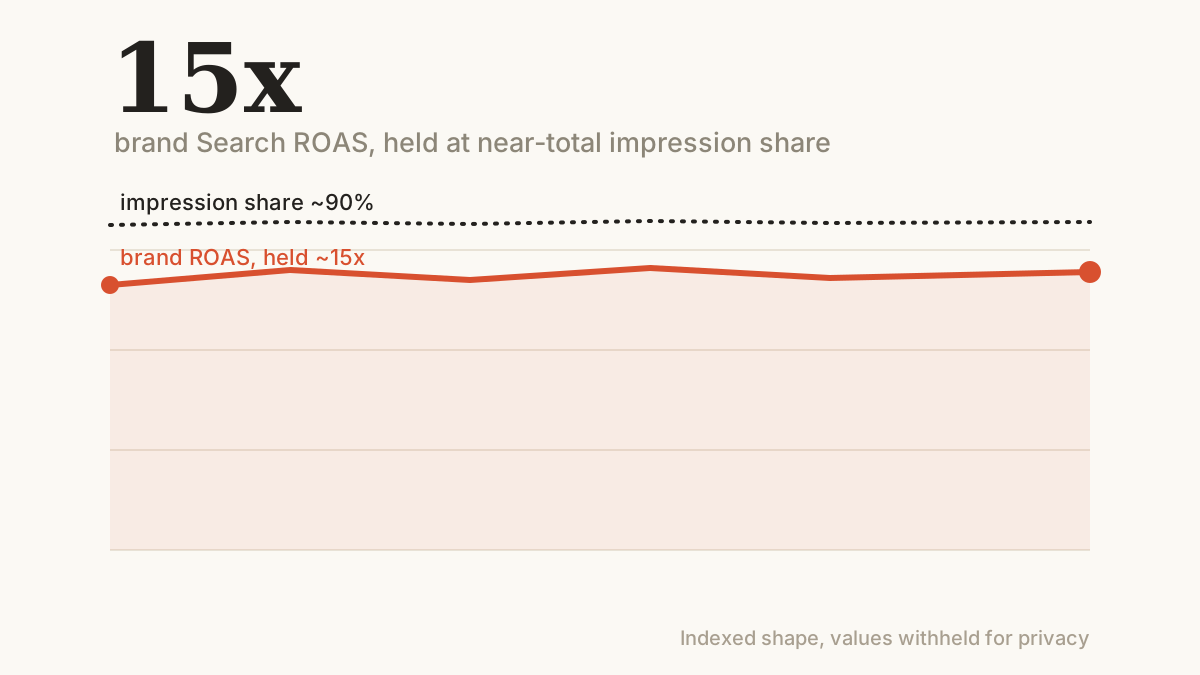
On a large account we have defended for years, brand Search holds roughly 15x ROAS at around 90% impression share, year after year. That combination, very high ROAS and near-total coverage, is what a well-defended brand looks like.
a Hold the brand at near-total coverage
The brand campaign on this account has held impression share in the high eighties to high nineties percent for years, at a ROAS around 15x and higher in some years. Near-total impression share means that when someone searches the brand, our client is almost always there, first, and there is very little room left for a competitor to slip in above them.
That coverage is not free or automatic; it is actively maintained. Brand terms still need a campaign, a budget and a watchful eye on impression share, because the moment coverage slips is the moment a competitor's brand bid starts paying off at your expense.
Near-total brand impression share at 15x ROAS is the most efficient defense in the account.
b Hold the line on competitor terms
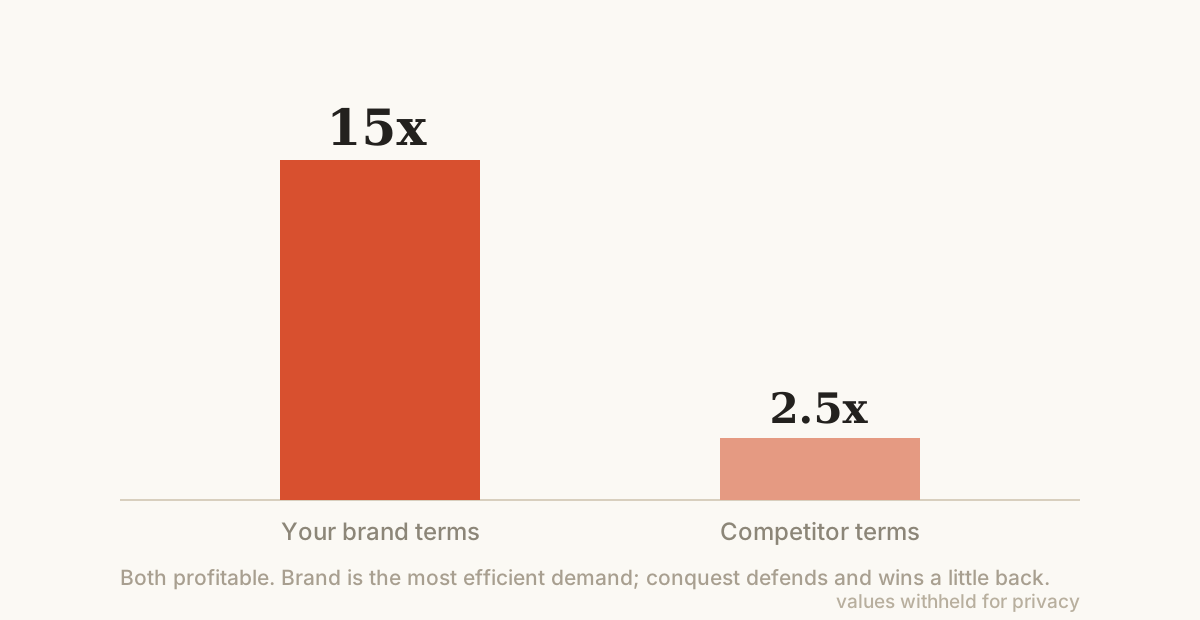
Conquest is the other half. On the same account, competitor and conquest terms run at roughly 2.5x ROAS, a fraction of brand but still profitable. You will never match your own brand ROAS on a competitor's name, and that is fine: the job of conquest is to win incremental customers and to make skimming your brand a two-way street, not to be your most efficient line.
Held at a sensible target, conquest pays for itself while it defends. Run without a target, it is the fastest way to waste money in the account, which is why it stays in its own campaign with its own ceiling.
c Defend, do not overspend
Brand defense has a failure mode in the other direction: pouring budget into brand terms that face no competition, where the traffic genuinely would have converted anyway. The skill is calibrating coverage to the actual threat. When competitors are active on your name, near-total impression share earns its keep. When the page is quiet, you can ease off and let organic do more of the work.
Beyond bidding, a trademark complaint with Google can stop competitors from using your name in their ad text, which raises the cost of attacking your brand in the first place. Defense is cheapest when you make the brand expensive to attack.
The most efficient demand in the account, protected.
Held with discipline, brand Search runs at roughly 15x ROAS at around 90% impression share, and conquest holds competitor traffic at about 2.5x. Together they protect the highest-converting demand the account has from leaking to rivals, and win a little of the rivals' demand back in return.
It is the most efficient work in the account, and the easiest to undervalue, right up until a competitor moves on your name and you watch your best customers click their ad.
- Brand defense protects your cheapest, highest-converting traffic. Undefended, 15 to 40 percent of it can leak to competitors.
Checking your own brand exposure.
Search your own brand name and see who shows up above you. If competitors are running ads on your terms and you are not, you are leaking your most valuable traffic. Then check your brand impression share: if it is well below the high eighties, there is room a competitor can take, and likely already is.
Keep brand in its own campaign so you can see its true ROAS and impression share, rather than burying it in a blended Search number where you cannot tell whether you are covered. And weigh conquest against your margin: it is worth running at a target, but it is not the place to chase volume.
Defend without overspending.
Brand defense fails in two opposite directions, and we watch for both. The first is slipping coverage: brand impression share drifting down as a competitor moves in or a budget cap bites. Because brand is so efficient, a few points of lost impression share is a few points of your best customers handed to someone else, so we treat brand impression share as a number to actively hold, not set and forget.
The opposite failure is overspending on brand that faces no threat. When no competitor is on your name, some of that brand traffic genuinely would have converted anyway, and pouring budget into it just buys clicks you would have had for free. We calibrate coverage to the actual competitive pressure: near-total when rivals are active, lighter when the page is quiet and organic can carry it.
Conquest is its own watch point. Bidding on competitor terms is profitable held at a target and a fast way to waste money without one, because you are always the underdog on someone else's name. We keep conquest in its own campaign with its own ceiling and watch it for the creep that turns a defensive play into a budget leak.
Finally, we watch the non-bidding levers. A trademark complaint with Google can stop competitors using your name in their ad text, which raises the cost of attacking your brand in the first place. Defense is cheapest when the brand is expensive to attack, so the legal and policy side is part of the watch list, not an afterthought.
Calibrating coverage to the threat.
The hard question in brand defense is not whether to run a brand campaign, it is how hard to run it. Spend too little and you leak your best traffic; spend too much and you pay for clicks that were yours anyway. Calibration is the skill, and it comes down to reading the actual competitive pressure on your name.
When competitors are active on your brand, push for near-total coverage. If rivals are bidding on your name, every point of impression share you cede is your most ready-to-buy customer handed a competitor's ad. Here, holding the high-eighties to high-nineties percent impression share at a 15x-class ROAS is some of the most efficient spend in the account, and worth defending hard.
When the page is quiet, ease off. With no competitors on your name, a share of brand traffic genuinely would have converted through organic anyway, so pouring budget into brand just buys clicks you would have had free. We pull back coverage when the threat is low and let organic carry more, watching impression share so we can ramp back the moment a competitor appears.
Hold conquest on its own ceiling. Bidding on competitor terms is profitable at a target and a money pit without one, because you are the underdog on someone else's name. It stays in its own campaign with its own budget so a defensive play never turns into a leak.
Make the brand expensive to attack. A trademark complaint with Google stops competitors using your name in their ad text, which raises their cost and lowers their click-through on your terms. The cheapest brand defense is the one that discourages the attack before it starts, so the legal lever sits alongside the bidding one.
The hardest part is measuring incrementality honestly, because the objection "they would have found us anyway" is sometimes true. The way to answer it is to watch what happens to total brand conversions when brand coverage changes, and to read auction insights for who else is showing on your name. If pulling back brand spend on an unthreatened term costs you almost nothing, that term was not incremental; if it costs you sales because a competitor was lurking, it was. We let that evidence, not dogma, set the coverage.
Auction insights is the radar for all of this. It shows which competitors appear on your brand terms, how often, and how aggressively, so we can see a threat building before it shows up in lost clicks. A new entrant climbing your brand impression share is the signal to tighten coverage; a quiet auction is the signal it is safe to ease off and let organic carry more.
There is also a reseller and partner wrinkle worth watching. Sometimes the advertisers on your brand are your own affiliates or retail partners, not rivals, and bidding against them just raises your own costs. Part of brand defense is knowing who is actually on your name, and handling authorized partners through policy and agreement rather than an expensive bidding war against your own distribution.
What to remember.
Brand terms are the cheapest, highest-converting traffic in the account, which is exactly why competitors bid on them. Undefended, 15 to 40 percent of that traffic can leak away.
Own your name at near-total impression share for a very high ROAS, hold competitor terms at a sensible target, and calibrate coverage to the real threat. It is the highest-ROAS and most undervalued work in the account.
- Brand Search held at roughly 15x ROAS and ~90% impression share for years
- Conquest terms held profitably at about 2.5x ROAS
- The 15-40% brand-traffic leak to competitors prevented
- Brand kept in its own campaign so its true ROAS and coverage stay visible