
Switching agencies resets the clock every time.
Google Ads rewards accumulated knowledge: which audiences convert, which queries waste money, what happened last peak season, why a structure is built the way it is. Almost none of that lives in the platform. It lives in the team running the account. So every time a brand switches agencies, most of it is lost.
The new team starts over: relearning the account, rediscovering the negative keywords, remaking the mistakes the last team already corrected, rebuilding the context that made the account efficient. The platform's automated systems reset too, dropping back into a learning phase whenever the structure and signals are reworked. For six months to a year, the brand pays for that reset in efficiency, and then often switches again before the new team has compounded any advantage.
The alternative is rarely shown off: stay put, and let the knowledge and the data compound. We have one account that shows what that looks like over more than a decade.
Continuity, and the discipline to weather change.
Compounding is mostly the result of not resetting. The same team has run this account for over a decade, which means the context never had to be rebuilt: the negatives accumulate, the structure evolves instead of being torn down, and every seasonal cycle and product launch adds to a base of knowledge rather than starting a new one.
But continuity is not the same as standing still. Over a decade, Google changed the rules many times: new campaign types, the shift to automated bidding, and a major measurement-era disruption that scrambled conversion tracking across the whole industry. Holding a high ROAS through all of that took active adaptation on top of continuity, weathering each change without losing the thread of what the account had already learned.
That combination, a stable team plus continuous adaptation, is what long-term Google Ads management actually is. The compounding comes from never throwing the accumulated knowledge away.
- Keep the team and the context
- Evolve the account, do not reset it
- Adapt through every platform change
What a decade of compounding looks like.
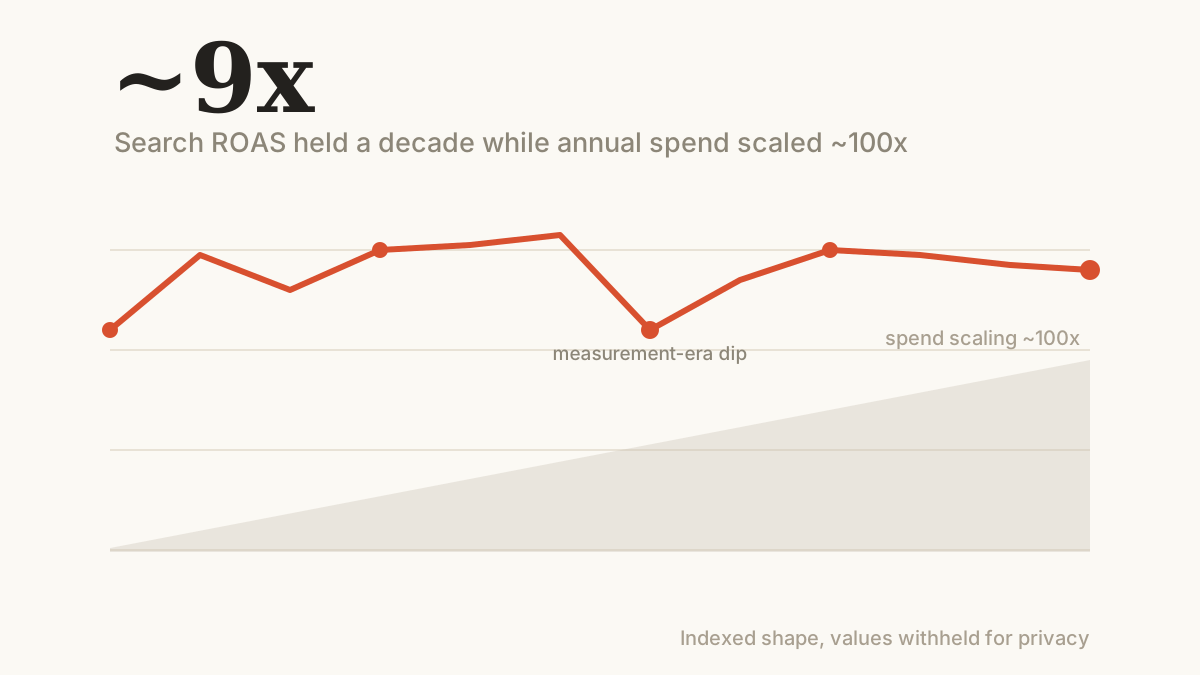
Across more than a decade, this account's Search ROAS has held in a high band, roughly 8x to 10x, while annual spend grew about 100x from where it started. Holding efficiency while scaling that hard is the whole demonstration.
a Hold efficiency while scaling 100x
The hard part of scaling is that efficiency usually erodes as you grow: you exhaust the cheap demand and push into thinner, more expensive traffic. This account grew annual spend roughly 100x over the decade and still held Search ROAS in the 8x to 10x band. That is only possible because the account kept getting smarter as it got bigger, with a decade of accumulated data steering every new dollar.
A new team scaling the same account from scratch would have spent years rediscovering what this one already knew. The compounding is the difference between scaling on top of a decade of learning and scaling blind.
Scaling spend ~100x while holding a high ROAS is what accumulated knowledge buys you.
b Weather the seams
The decade was not a smooth line. There was a clear dip during the industry-wide measurement disruption, when conversion tracking got harder across every account, and ROAS fell for a stretch. The account did not panic-reset; it adapted, and ROAS recovered to roughly 10x in the following years.
That recovery is itself an argument for continuity. A team with a decade of context could tell the difference between a measurement artifact and a real performance drop, and respond correctly. A team six weeks into the account might have torn up a working structure chasing a problem that was in the tracking, not the campaigns.
c The base that keeps paying
Underneath the scaling sits a decade of compounded assets: an enormous negative-keyword base, a structure refined through many cycles, and brand terms defended at high efficiency the entire time. None of it is dramatic on its own. Together it is a moat that a new account does not have and cannot quickly build.
This is the simple case for staying put. The account is not efficient because of one clever campaign; it is efficient because nobody threw away ten years of work and started over.
Efficiency that grew instead of resetting.
Over more than a decade, one team, the account held Search ROAS in a high 8x to 10x band while annual spend scaled roughly 100x, and recovered from a measurement-era dip back to around 10x. That is what compounding looks like: not a single spike, but efficiency that held and grew because the knowledge underneath it was never thrown away.
- Compounding is the opposite of agency-hopping. The advantage is the decade of context a new team does not have.
Before you switch agencies again.
Switching makes sense when an account is genuinely neglected or badly run. But if you switch on a normal cycle every year or two, you may be paying the reset tax over and over and never reaching the part of the curve where the account compounds. Each new team spends its first months relearning what the last one knew, and you fund that relearning every time.
If you do switch, protect the compounding assets: keep ownership of the account, the data, the negative-keyword lists and the conversion history, so a new team inherits the decade rather than starting from zero. The reset is far cheaper when the knowledge is not thrown out with the relationship.
What threatens compounding.
The obvious threat is the reset itself. Every agency switch on a normal cycle pays the relearning tax again: months of a new team rediscovering the negatives, the structure and the context the last team already knew, while the platform's automation drops back into learning. We watch for switches made out of habit rather than necessity, because the reset is rarely worth it on an account that is merely fine.
The quieter threat is losing the compounding assets on the way out. When a brand switches without keeping ownership of the account, the data, the negative-keyword lists and the conversion history, a decade of accumulated knowledge is discarded with the relationship. We watch ownership closely, because a switch that preserves the assets costs far less than one that throws them away.
A subtler risk is misreading the seams. Over a decade the platform changes the rules repeatedly, and an industry-wide measurement disruption can look exactly like a performance collapse. The value of context here is judgement under that kind of noise: knowing when a sudden drop is the tracking and not the campaigns, so you adapt instead of tearing up a structure that was working fine.
Finally, continuity is not an excuse to stand still. An account left on autopilot for years compounds nothing; it just ages. We watch that a long-running account keeps evolving, weathering each platform change and adding to its base of knowledge, so the decade of context stays an asset rather than becoming a museum.
What actually compounds.
"Compounding" is abstract until you name the specific assets that accumulate, because that is what a new team starting over does not have and cannot quickly rebuild. Over a decade, four things stack up, and together they are the moat.
The negative-keyword base. Years of search-term mining produce a vast, niche-specific list of what wastes money in this market. A new team rediscovers those negatives one expensive query at a time; the long-running account already has them, so its budget starts cleaner on day one of every new campaign.
The structure, refined through cycles. The campaign and ad-group structure has been shaped by many peak seasons, launches, and failures. It encodes hard-won knowledge about how this business converts, which a fresh build does not contain yet.
The conversion history and the algorithm's learning. Smart Bidding gets better the more relevant conversion data it has, and a decade of it is a head start no new account can buy. Every switch resets that learning back into a cold start.
The brand defended the whole way. Brand terms held at high efficiency for years mean the most valuable demand was never leaking while the rest compounded. Underneath all four sits the same team carrying the context, which is why they could tell a measurement-era artifact from a real drop and adapt instead of panic-resetting. None of these is dramatic alone; together they are why the account holds a high ROAS while spend scales, and why throwing them away on a routine agency switch is so much more expensive than it looks.
It is worth being concrete about what a switch actually costs, because "reset the clock" is easy to wave away. The new team spends its first weeks just learning the account, then rediscovers the negatives one wasted query at a time, then rebuilds a structure whose logic it does not yet understand. Meanwhile the platform's automated bidding drops back into a learning phase whenever the structure and signals are reworked. That is months of degraded efficiency, paid for in real spend, before the new team even reaches the level the old one had already passed.
So our advice when a brand is genuinely unhappy is not always "stay"; sometimes a switch is right. But it is to switch for a real reason, not on a calendar, and to protect the compounding assets on the way. Keep ownership of the account, the data, the conversion history and the negative lists, so a new team inherits the decade instead of starting from zero. The relationship can end without the asset being destroyed.
The deeper point is that the compounding is not magic and not luck; it is the absence of resets. An account that is never torn down keeps every lesson it has ever learned and keeps adding to them. That is an advantage no clever tactic can match and no new team can shortcut, and it is the plain case for choosing a partner you can stay with.
The decade is also a record of adaptation, which is what makes the continuity valuable rather than complacent. New campaign types, the move to automated bidding, the measurement-era disruption that scrambled conversion tracking across the industry: holding a high ROAS through all of it was not coasting, it was weathering each change without losing the thread of what the account had already learned. Continuity only compounds when the team keeps adapting on top of it.
What to remember.
Most of what makes a Google Ads account efficient lives in the team, not the platform, so switching agencies resets the clock and you pay for the relearning every time.
The opposite is compounding: one account, one team, a high ROAS held for over a decade while spend scaled roughly 100x and weathered a measurement-era dip. The advantage is not a clever tactic; it is a decade of context that was never thrown away.
- Search ROAS held in a high 8x to 10x band for over a decade
- Annual spend scaled roughly 100x without losing efficiency
- Recovered to about 10x after the industry-wide measurement disruption
- A decade of negatives, structure and brand defense compounding into a moat