
Google Ads does not hold its ground on autopilot.
The pitch for automation is that an account can be set up well and then largely left alone. In reality, a Google Ads account is run in a moving market: competitors change bids, costs drift up, the product mix shifts, seasonality turns, and Google itself changes the rules every few months. An account that is not actively managed does not hold steady. It slowly slides.
The slide is hard to see from inside, because nothing breaks. Spend keeps going out, conversions keep coming in, the campaigns keep running. What erodes is efficiency: the wasted spend that never gets pruned, the bid strategy that drifts off target, the new competitor who is taking the cheap conversions you used to win. By the time it shows up in the headline numbers, months have passed.
Proving the cost of that drift normally requires a control group you never get. On this account, we got one.
A clean before, during and after.
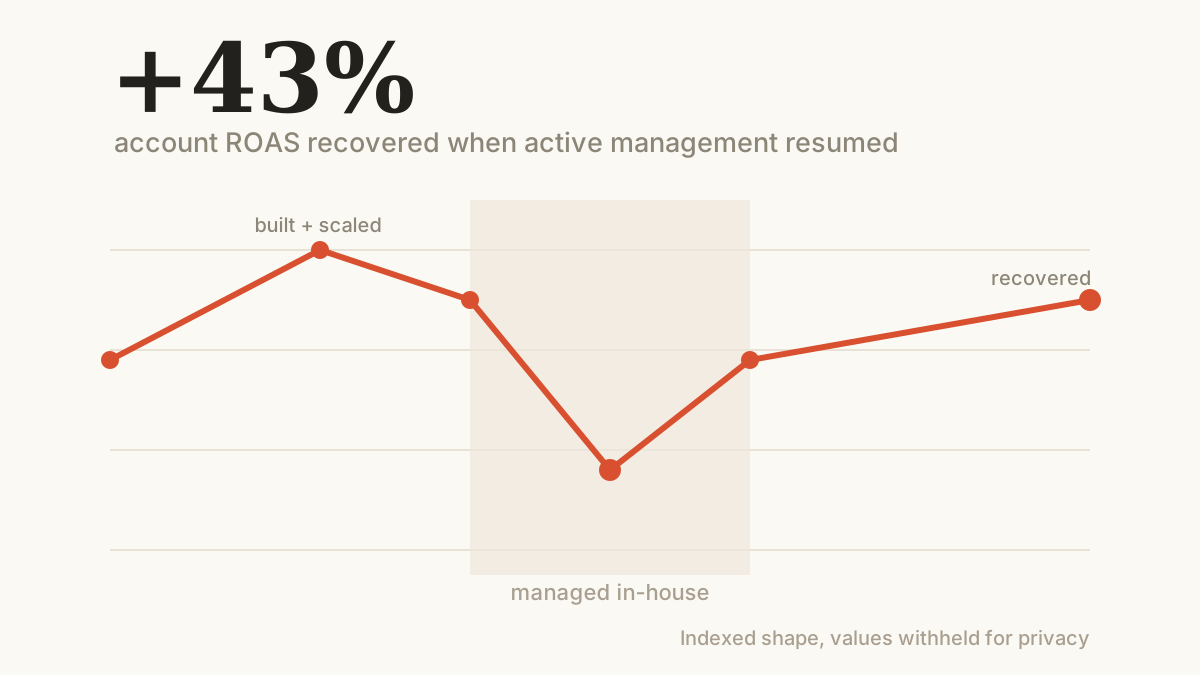
This is not a hypothetical. We built this account from zero and scaled it. Then the client brought it in-house for a year, where it stagnated and ROAS bottomed. Then we resumed management and it recovered. Same account, same product, same market: the only thing that changed across those three phases was whether the account was being actively worked.
When we resumed, the work was not dramatic, and that is the point. It was the accumulation of ordinary active management: pruning the wasted spend that had built up, getting the bidding back on a sensible target, rebuilding the structure that had drifted, and re-pointing budget at what was actually converting. None of it is a silver bullet. All of it together is what active management means.
That ongoing, behind-the-scenes work is the substance of our Google Ads management: not one big move, but the steady compounding of many small correct ones, week after week.
- Prune the accumulated waste
- Reset bidding to a real target
- Re-point budget at what converts
The dip, and the recovery.
The account's history reads as three clean phases: built and scaled under management, stagnated during the in-house year, recovered when we resumed. The recovery is the headline: account ROAS came back +43% the year we took it back over.
a What management had built
It is worth remembering where the account started, because it sets the baseline. Under our management from zero, the founding year delivered +198% net revenue at a +30% higher account ROAS, and Performance Max later ramped +153% as it matured. This was not a struggling account that we happened to be running. It was a well-built, well-scaled one.
That matters because it rules out the easy objection. The in-house dip was not the account regressing to its natural level; it was a strong account losing ground without active hands on it.
The account was built and scaled under management, so the in-house dip was a loss, not a reversion.
b The in-house year
Taken in-house, the account stagnated and its ROAS bottomed. Nothing collapsed: that is exactly how the drift works. The campaigns kept running, the spend kept flowing, and efficiency eroded as the routine optimization stopped. The waste accumulated, the bidding drifted, and the edge slipped to competitors who were still actively working their accounts.
This is the most honest evidence we have for what active management is worth, precisely because nothing went obviously wrong. The cost of stepping back was not a disaster; it was a year of leaving money on the table.
c The recovery
When we resumed, account ROAS recovered +43% year over year. On a stricter cut of the data the recovery is more conservative, in the mid-teens percent, but the direction is unambiguous either way: the same account, actively managed again, made meaningfully more from the same spend.
The recovery came from the ordinary work resuming, not from a reinvention. That is the reassuring and slightly boring truth of account management: the value is in the consistency, and you feel its absence as a slow leak rather than a sudden break.
The cleanest control group we have.
Built and scaled under management, stagnated in-house for a year, recovered +43% when management resumed. It is rare to get a before, during and after this clean on a single account, which is what makes it the most honest answer we can give to "what does active management actually buy?"
The answer is not a miracle number. It is the difference between an account that is worked and one that is left to coast, and over a year that difference was worth roughly two-fifths of the account's ROAS.
- Same account, same market. The only variable that changed was whether anyone was actively working it.
Whether your account is drifting.
You will rarely get a clean control group on your own account, so look for the symptoms of drift instead. Is wasted spend accumulating in your search terms without anyone pruning it? Has your bidding target not been revisited in months? Is your structure the same as it was a year ago while your product mix has moved on? Those are the signs that an account is coasting.
Automation is a tool inside active management, not a replacement for it. Smart Bidding still needs someone setting the right target, feeding it clean data, and steering the budget. The accounts that slide are not the ones that use automation; they are the ones that mistook automation for a reason to stop paying attention.
The signs an account is drifting.
Drift never announces itself, so we watch for its symptoms rather than waiting for the headline numbers to drop. The clearest is accumulating waste: search terms spending without converting, month after month, because nobody is pruning them into negatives. A growing tail of wasted spend is the surest sign an account is being left to coast.
The second symptom is stale bidding. A Target ROAS or CPA set a year ago, on last year's margins and last year's conversion volume, is almost certainly wrong now. We watch whether targets have been revisited as the business changed, because a target nobody has touched is a target that has drifted off the real economics.
The third is structural staleness: last year's campaign structure running on this year's product mix, new bestsellers buried in old campaigns, retired products still live. The account keeps spending, but against a map of a business that no longer exists. We watch whether the structure has evolved with the catalog or frozen in place.
The subtlest trap is mistaking automation for autopilot. Smart Bidding is a tool inside active management, not a replacement for it; it still needs the right target, clean data and a steering hand. The accounts that slide are not the ones that use automation, they are the ones that treated automation as permission to stop paying attention.
What active management does, week to week.
"Active management" sounds vague, so here is what it concretely means, because the +43% recovery came from this routine resuming, not from one heroic move. None of it is dramatic; all of it together is the difference between an account that compounds and one that coasts.
Weekly: prune the waste. Read the search-term report, turn non-converting queries into negatives, and catch the spend that accumulates the moment no one is watching. This alone is the first thing a coasting account stops doing, and the leak it opens is the clearest symptom of drift.
Weekly: mind the bids and budgets. Check that the bid strategies are tracking their targets, shift budget toward what is converting and away from what is not, and catch a campaign that has wandered off its goal before it spends a month doing so.
Monthly: revisit targets and structure. Re-set Target ROAS or CPA against current margins and conversion volume, retire dead products and campaigns, and evolve the structure as the product mix moves. A target set a year ago on last year's economics is almost certainly wrong now.
Continuously: test and adapt. New ad copy into the rotation, new audiences and signals, and a response to whatever Google changed this quarter. Automation is a tool inside this loop, not a substitute for it: Smart Bidding still needs the right target, clean data, and a steering hand. The account that slid in-house did not break, it just stopped getting this attention, and getting it back is what the recovery was.
It helps to picture what each lever catches that coasting misses. The weekly search-term pass catches a new competitor's product name leaking into your prospecting before it spends a month. The bid check catches a Target ROAS that drifted high after a tracking change and throttled spend. The monthly structure review catches a new bestseller stranded in an old, under-funded campaign. None of these trip an alarm; they just slowly cost money until someone looking finds them.
The in-house year is the clean proof of what stopping costs. Nothing dramatic happened, which is exactly the point: the campaigns kept running, the spend kept flowing, and efficiency eroded a little each month as the routine lapsed. The bottom was not a crash, it was the accumulated weight of small optimizations not happening, which is why the recovery, when the routine resumed, came back as a step change rather than a rescue.
That is also why we are wary of the pitch that an account can be fully automated and left. Automation handles the bidding math beautifully, but it does not decide that a target is now wrong, that a product line has shifted, or that a competitor has changed the game. Those are judgement calls, made weekly by someone who knows the account, and they are the part that does not show up until it stops.
The shape of the recovery is worth dwelling on, because it tells you what management actually is. It did not come from one clever move that had been missing; it came from a dozen small, ordinary disciplines resuming at once, the waste pruned, the targets re-set, the structure refreshed, the tests restarted, each adding a little and compounding into a step change. That is the real answer to "what does active management buy?": not a silver bullet, but the steady accumulation of small correct decisions that an unmanaged account stops making.
It is also a deliberately low-drama way of working, and that is a feature. We do not chase the account with big risky swings; we make many small, reversible improvements and let them compound. Drama in an account is usually a sign of neglect followed by panic, not of good management. The accounts that hold their performance for years are the boring ones, worked steadily, where nothing ever has to be rescued because nothing was ever left to slide.
What to remember.
A Google Ads account does not hold its ground on autopilot. Left alone, it drifts, and the drift is a slow leak you do not notice until months have passed.
On the cleanest control group we have, a year in-house cost the account efficiency that came back +43% the moment active management resumed. The value of management is not one heroic move; it is the consistency of many small correct ones.
- Account ROAS recovered +43% the year active management resumed
- A clean before-during-after: built under management, stagnated in-house, recovered
- Recovery driven by ordinary work resuming, not a reinvention of the account
- The cost of coasting shown as a slow leak, not a visible break