
If the data is wrong, everything downstream is guesswork.
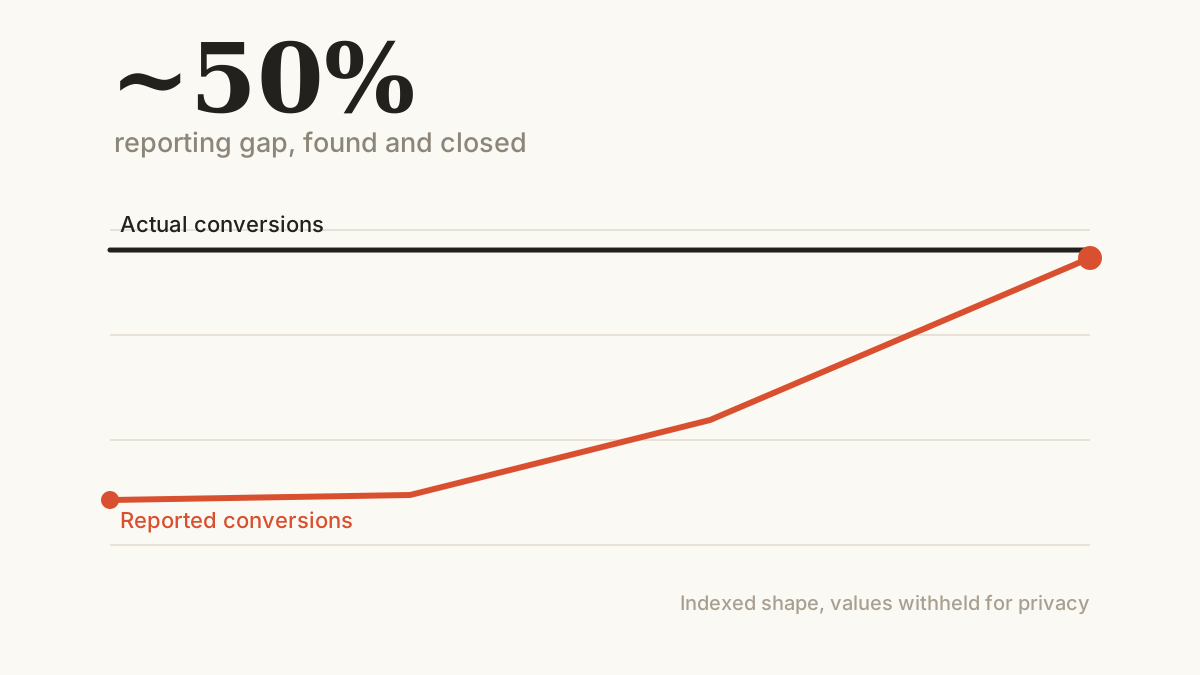
Bidding strategies, budgets, creative decisions, board reports: all of it assumes the conversion data is true. It often is not. We have taken over accounts where the gap between what the platform reported and what actually happened was roughly 50%. When measurement is that far off, Smart Bidding optimizes toward a phantom, and every decision built on the reports is wrong without anyone noticing.
A gap like that is rarely one big obvious break. It is usually a pile of small ones: a tag that fires twice, a thank-you page that some traffic skips, consent settings that drop a slice of conversions, a cross-domain checkout that loses the session. Each is minor on its own. Stacked, they add up to an account optimizing on numbers that are half fiction.
The harder version of the problem is a brand-new account with no measurement at all: no conversion tracking, no analytics history, nothing to learn from. Either way, the first job is not advertising. It is making the data real.
Build the measurement layer before the media.
We rebuild measurement from the bottom up: define the conversions that matter, implement them cleanly in GA4 and Google Ads, and verify that what fires on the site matches what lands in the reports. Macro conversions (the purchase, the lead, the checkout) are the foundation. Micro conversions (add-to-cart, key page engagement, deeper funnel steps) are the early signal that lets bidding learn quickly, especially on an account with no history.
Verification is the part most teams skip and the part that matters most. A tag that fires is not the same as a tag that reports correctly, so we reconcile the platform numbers against the back-end orders or leads until they agree. If Google Ads says one thing, GA4 says another, and the order system says a third, none of them can be trusted until they are reconciled.
This is the foundation under our conversion tracking and GA4 setup work, and the reason the bidding playbooks elsewhere on this site can be trusted at all. Value-based bidding, prospecting targets, PMax exclusions: every one of them is only as good as the measurement underneath it.
- Define macro and micro conversions
- Implement in GA4 and Google Ads
- Verify reported equals actual
What rebuilding measurement actually does.
Two situations show the work. In one, an established brand was making decisions on badly understated data. In the other, a beauty brand started with no tracking at all and needed a measurement layer built from scratch before a single campaign could be trusted.
a Close the gap between reported and real
For the established brand, the work was reconciliation: finding why the reports and reality disagreed by roughly 50%, fixing the tracking, and rebuilding a model the team could finally trust. Closing a gap that size does not just make reports prettier; it changes which campaigns look like winners, which means it changes where the budget goes.
That is why measurement is so high-impact and so invisible. Once the data was right, campaigns that had looked mediocre turned out to be the best performers, and budget that had been flowing to phantom conversions was redirected to real ones. Fixing broken measurement is one of the highest-return moves in the whole account, because it corrects every downstream decision at once.
A 50% measurement gap does more than misreport results. It misdirects the entire budget.
b Build the signal layer from zero
For the brand-new account, there was nothing to lean on: no history, no tracking, no feed. We built the macro and micro conversion layer first, more than 10 events feeding the account, so Smart Bidding had real signal to learn from despite no history.
Micro conversions were the unlock. They gave the algorithm an early read on quality long before purchase volume existed, and they let us segment remarketing audiences far more precisely: someone who viewed three products and started a checkout is a different audience than a bounce, and worth a different message. On a new account with no purchase history, those early signals are the difference between bidding that learns in weeks and bidding that flails for months.
On a new account, micro conversions are how the algorithm learns before purchases exist to learn from.
c Turn trustworthy data into results
Measurement is invisible, so it is worth being concrete about what it enables. On that brand-new account, the first year on properly built tracking produced +198% net revenue at a +30% higher account ROAS.
Those numbers are an advertising result, but they were only reachable because the data underneath them was real from day one. Every bidding decision that drove that growth was made on signal the algorithm could trust, which is exactly why we refuse to start on the media before the measurement is sound.
Real data, and the results that ride on it.
On one account, a roughly 50% gap between reported and actual conversions was found and closed, so the team finally optimized against the truth. On another, measurement built from zero, more than 10 macro and micro events, underwrote a founding year of +198% net revenue at +30% higher ROAS.
Measurement never shows up as a line item the client gets excited about. It shows up as every other number being trustworthy. That is why we do it first.
- Measurement is the cheapest performance lever there is, because everything else is built on top of it.
How to know if your data is lying to you.
The simplest test is to compare your Google Ads and GA4 conversion counts against the orders or leads in your back-end system over the same window. If they disagree by more than a little, you have a measurement problem, and it is almost certainly distorting your optimization. The size of the gap is the size of the opportunity.
Pay particular attention to the usual culprits: duplicate tag fires, conversions counted on page loads that some sessions skip, consent and privacy settings dropping a slice of data, and cross-domain or app checkouts breaking the session. Any one of them can open a gap big enough to mislead the bidding.
If you are launching something new, build the measurement before the media, including micro conversions, so the account has signal from day one instead of waiting months for purchase volume. The accounts that scale fastest from zero are the ones that could measure quality before they had revenue.
How measurement breaks silently.
The dangerous thing about measurement is that it fails without a warning light. A tag that fires looks healthy in a tag debugger and can still report the wrong number, so the first thing we watch is whether a firing tag actually reconciles with a real order or lead. Firing is not the same as correct, and the gap between them is invisible until you check.
Consent and privacy settings are easy to overlook. A consent banner or a regional privacy rule can drop a slice of conversions before they are ever counted, so the account optimizes on a biased sample without anyone realizing the sample is biased. We watch the consent configuration and the share of traffic it affects, because a "tracking problem" is often a consent problem in disguise.
Duplication and timing are the next watch points. A tag fired twice, or a conversion counted on a page load that some sessions skip, inflates or deflates the count in ways that look plausible. Cross-domain and app checkouts break the session entirely, orphaning conversions from the click that drove them. Each is a small leak that compounds into a misleading total.
Above all, we watch the three-way reconciliation: Google Ads, GA4, and the back-end order or lead system should agree within a small margin. When they diverge, none of them can be trusted until the divergence is explained. The accounts that stay healthy are the ones where that reconciliation is a standing check, not a one-time setup task.
The events we build.
"Macro and micro conversions" is easy to say and easy to skip, so it is worth being concrete about what we actually build, because the layer is what lets bidding learn fast, especially on an account with no history.
Macro conversions are the money events. The purchase or the qualified lead, with accurate value attached, is the foundation everything else optimizes toward. We make sure exactly one primary conversion action represents the real outcome, so the bidding is not confused by counting a newsletter signup as if it were a sale.
Micro conversions are the early signals. Add-to-cart, begin-checkout, key-page views, deep scroll, repeat visits: none of these are the sale, but together they tell the algorithm who is behaving like a buyer long before purchase volume exists. On a brand-new account, these signals are the difference between bidding that learns in weeks and bidding that flails for months waiting for enough purchases.
The micro layer also powers segmentation. Someone who viewed three products and started a checkout is a different audience, worth a different message and a different bid, than a bounce. Those event-based audiences feed remarketing and the audience signals that accelerate Performance Max and Demand Gen, so the measurement work pays off across every channel, not just reporting.
And every event is verified, not assumed. A tag that fires is not a tag that reports correctly, so each event is reconciled against the back-end until the platform numbers and reality agree. This is the boring step that makes the value-based bidding, the prospecting targets and the PMax exclusions elsewhere on this site trustworthy, because all of them inherit whatever this layer tells them. It is the same reconciliation habit our conversion tracking work is built on.
Two modern wrinkles make this harder than it used to be, and we build for both. The first is consent: privacy rules and cookie banners mean a slice of conversions is never observed unless consent mode and modeling are set up correctly, so we configure them deliberately rather than letting the platform under-count. A consent setup left on defaults is a big reason reported conversions drift below reality.
The second is the move server-side. Browser-only tracking leaks data to ad blockers, ITP, and lost sessions, so where it matters we send conversions server-side and use enhanced conversions to recover the matches that client-side tags drop. The goal is not more tags; it is more of the truth reaching the platform, so the bidding learns from what actually happened rather than from the fraction a browser happened to record.
None of this is set-and-forget. Sites get redeployed, tag managers get edited, a developer ships a change that breaks a trigger, and the measurement degrades without a warning. So reconciliation is a standing check, not a launch task: we compare platform conversions against the back-end on a cadence, because the only thing worse than no tracking is tracking everyone trusts that has gone wrong.
What to remember.
Trustworthy measurement is the foundation every other playbook stands on. A reporting gap of roughly half will misdirect a whole budget without anyone seeing it; missing tracking on a new account leaves the algorithm blind.
Define the conversions, implement them cleanly, verify reported against real, and only then let the bidding strategies do their work. It is the least glamorous step and the one with the highest return, because it corrects everything downstream at once.
- A roughly 50% gap between reported and actual conversions found and closed
- Measurement built from zero on a brand-new account, 10+ macro and micro events
- Trustworthy data underwrote a +198% founding-year revenue result at +30% higher ROAS
- Every tag verified so reported conversions match what actually happened