
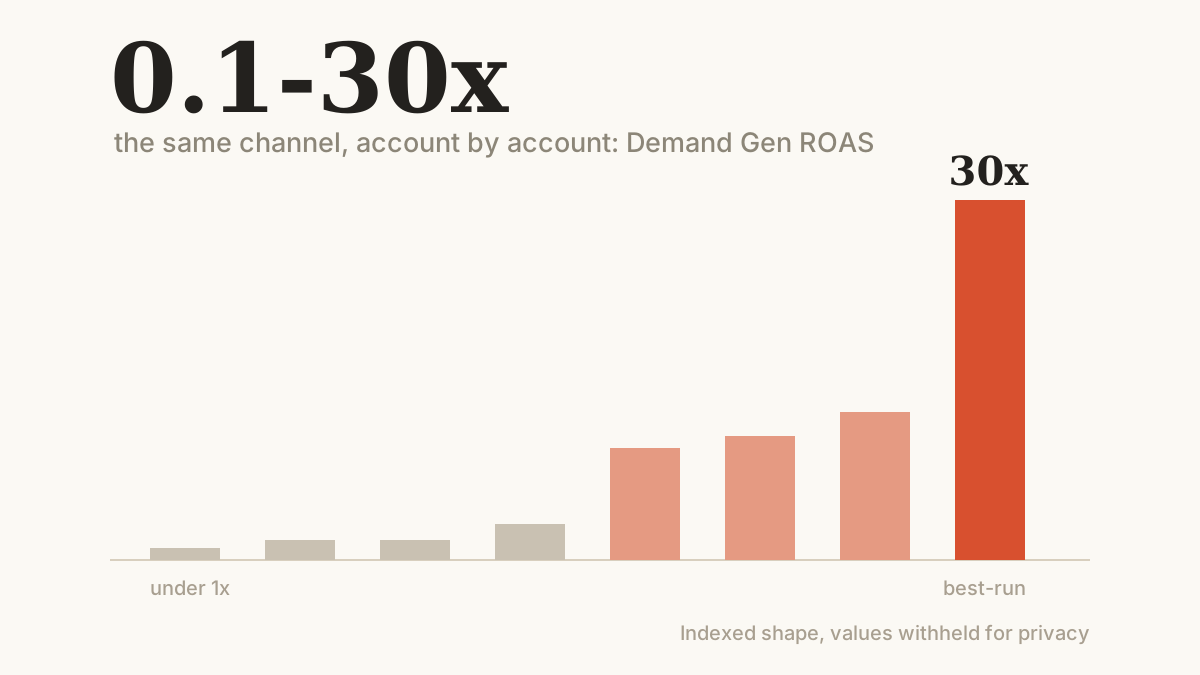
Demand Gen has the widest performance spread of any channel.
Demand Gen is Google's upper-funnel, visual prospecting channel: image and video ads across the feed, Discover, Gmail and YouTube. It reaches people who are not searching for you yet, which is exactly why it is so easy to get wrong. There is no high-intent query carrying the campaign; the targeting, creative and measurement have to do all the work.
The result is the widest performance spread we see anywhere. Across the accounts we run Demand Gen on, ROAS ranges from under 0.1x to more than 30x. On roughly half of them, it sits below 1x. Same channel, same Google, wildly different outcomes, depending entirely on how it is set up and measured.
That spread is why Demand Gen has a bad reputation in a lot of accounts. A team launches it, it runs at a fraction of their Search ROAS, and they conclude the channel does not work for them. The honest read is different: an unprofitable Demand Gen campaign is almost always a setup problem or a measurement problem, not a channel problem. The proof is the account next door running the same channel at 30x.
Give it intent, give it signal, and measure it honestly.
A profitable Demand Gen campaign needs three things the unprofitable ones lack. First, real audience intent: built from your own data (site visitors, past purchasers, high-value lookalikes) rather than broad interest targeting that reaches everyone and converts no one. Second, enough conversion signal to bid on value, which means clean tracking and, ideally, value-based bidding once the volume supports it. Google's own guidance is to run Demand Gen on target ROAS once it has the data, and to seed it with a target a notch below your historical average so it can find its feet.
Third, and most often missed, honest measurement. Demand Gen is upper-funnel, so judging it purely on last-click ROAS at two weeks is the classic mistake: you are measuring a top-of-funnel channel with a bottom-of-funnel ruler and a stopwatch. We give it the window and the attribution view that match what it actually does.
On a strong account, those three together compound. The campaign that sustained 30x was not luck; it was tight audiences, clean signal, and the patience to let value bidding learn. This is the same prospecting discipline as our Google Ads management, applied to a visual channel instead of Search.
- Build audiences from your own data
- Feed it clean conversion signal
- Measure it for what it is
Why one account hits 30x and another sits under 1x.
The most useful thing about Demand Gen in our book is that we can see both outcomes side by side. The same channel that sustains 30x on one account runs below 1x on several others. Lining them up shows exactly which levers separate the two.
a The account that hit 30x
On the standout account, Demand Gen held above 30x ROAS across a full year, not a lucky month. It got there on tight, intent-rich audiences and clean signal, with value bidding pointed at revenue once the campaign had learned. The creative spoke to a specific buyer, the audiences excluded existing customers where appropriate, and the measurement was sound enough to bid on.
A number that high deserves a caveat we apply ourselves before we ever show a client: confirm the attribution lens. A 30x figure should be read on the same basis you read the rest of the account, not flattered by view-through credit. On this account it holds up on the standard ROAS basis, which is exactly why it is worth talking about.
Tight audiences plus clean signal plus value bidding is what a 30x Demand Gen campaign is made of.
b Why the others sit under 1x
On the accounts where Demand Gen runs below 1x, the pattern is consistent: broad targeting that reaches everyone, thin or missing conversion signal, and last-click judgement that buries whatever upper-funnel value the channel did create. The campaign never gets the intent or the data it needs, and then it gets blamed for the result.
This is not a reason to avoid Demand Gen. It is a checklist of what to fix before scaling it. Every sub-1x Demand Gen campaign we inherit fails on at least one of those three points, and usually all three.
c Measure it for what it is
Demand Gen reaches people before they are looking for you, so a share of the value it creates shows up later, in branded search and direct visits, not in a last-click line on the campaign. Judging it only on immediate last-click ROAS, at two weeks, systematically undercounts it and leads teams to switch it off right as it starts working.
We give it a fair window and read it against the role it plays in the funnel. That does not mean excusing a bad campaign; it means not killing a good one with the wrong ruler. The discipline is the same one in our conversion tracking work: measure each channel for the job it actually does.
A channel that pays, when it is built to.
Run with intent-rich audiences, clean signal and honest measurement, Demand Gen sustained 30x ROAS across a full year on the account that did all three. Run without them, the same channel sits below 1x. The lesson is not "use Demand Gen" or "avoid it." It is that Demand Gen rewards setup more than almost any other channel.
- Demand Gen is not a good or bad channel. It is a well-run or badly-run one, and the gap between them is enormous.
Before you write off Demand Gen.
If your Demand Gen is underperforming, check the three levers before you pull the budget. Are your audiences built from your own data, or are you reaching the whole internet? Is the conversion signal clean enough for value bidding, or is the campaign learning from noise? And are you judging it on last-click at two weeks, when it is an upper-funnel channel that pays back later?
If you are launching it fresh, seed the target ROAS a little below your historical average so the campaign can find traction, give it a budget with room to learn, and resist the urge to evaluate it before it has left the learning phase. Demand Gen punishes impatience harder than most channels.
Why Demand Gen gets misjudged.
The biggest watch point is the ruler. Demand Gen reaches people before they are searching for you, so a chunk of the value it creates lands later in branded search and direct visits. Judged on last-click ROAS at two weeks, it always looks worse than it is, and teams switch it off right as it starts working. We give it a window and an attribution view that match an upper-funnel channel.
The opposite distortion also exists: view-through credit can flatter Demand Gen and make a mediocre campaign look like a star. So when a Demand Gen number looks too good, we check the attribution basis before celebrating, and we read it on the same basis as the rest of the account rather than on a lens that inflates it.
Targeting is the next watch point. Broad interest audiences reach everyone and convert no one; the campaigns that pay are built on first-party data, customer lists and high-value lookalikes, with existing customers excluded where it makes sense. We watch what the audiences are actually made of, because that is usually the difference between the accounts at 30x and the ones under 1x.
Finally, creative fatigue and thin budgets. A visual channel burns through creative faster than Search, so flat performance is often a creative problem, not a targeting one. And a budget too small to leave the learning phase will never prove anything either way. We watch for both before drawing any conclusion about whether the channel can work.
Building the audiences.
The single biggest difference between the Demand Gen account at 30x and the ones below 1x is what the audiences are made of. Broad interest targeting reaches everyone and converts no one; the accounts that pay are built on data the business already owns. Here is the order we build in.
First-party data first. Customer lists, past purchasers, and high-intent site visitors are the richest signal a brand has, and they are the foundation of a profitable Demand Gen audience. Lookalikes built from high-value customers extend that reach without abandoning the intent that makes it work.
Exclude who you should not pay for. Existing customers, recent purchasers, and unqualified segments get excluded where it makes sense, so the budget reaches genuinely new demand instead of re-touching people who were going to convert anyway or never will.
Feed it clean conversion signal. Demand Gen runs best on value-based bidding once it has the data, and that data comes from the same macro and micro event layer the tracking playbook builds. Without clean signal, even a perfect audience is bidding blind.
Then give it a fair window. Because it reaches people before they search, a share of its value shows up later in branded search and direct visits. We seed the target a notch below the historical average, give the campaign budget room to learn, and judge it on an attribution view that matches an upper-funnel channel, not last-click at two weeks.
Creative carries more of the weight here than on Search, because Demand Gen is a visual, feed-style channel. A strong pool mixes formats, single image, portrait, video, carousel, and genuinely different hooks, so the system can match the creative to the surface and the person. A pool of one tired image is the fastest way to make a promising audience underperform, no matter how well it is built.
The exclusions matter as much as the inclusions. Beyond removing recent purchasers, we keep Demand Gen from cannibalizing the demand other campaigns would have captured anyway, so its reported value is closer to genuinely incremental reach. An upper-funnel channel that takes credit for bottom-funnel conversions flatters itself and starves the budget that should be funding real prospecting.
Finally, we read it next to the rest of the account, not in isolation. When Demand Gen is working, you often see it in branded search and direct traffic lifting, not only in its own last-click line. Watching those second-order signals is how we tell a genuinely profitable Demand Gen campaign from one that is merely claiming credit, which is the difference between the accounts at 30x and the ones that gave up at under 1x.
What to remember.
Demand Gen has the widest performance spread of any channel we run: under 0.1x to over 30x. That spread is execution, not luck.
Give it intent-rich audiences, clean conversion signal, and an honest measurement window, and it can be one of the most profitable lines in the account. Skip any of the three and it joins the half of accounts where it loses money and takes the blame.
- Demand Gen sustained above 30x ROAS across a full year on the best-run account
- The sub-1x pattern diagnosed: broad targeting, thin signal, last-click judgement
- Value-based bidding pointed at revenue once the campaign had real signal to learn from
- Upper-funnel value measured on a fair window instead of last-click at two weeks