
PMax launches easily, and a weak one never says so.
Almost anyone can launch Performance Max. You point it at a feed and a budget, and within a day it is spending across Search, Shopping, Display, YouTube and Gmail at once. Launching it well is the hard part, and because it is a black box, a weak launch does not announce itself: it just runs at a mediocre ROAS that everyone assumes is the channel's ceiling.
On a beauty brand we manage, PMax launched at a ROAS below 1.5x in its first year. Plenty of accounts would have called that the verdict on Performance Max and pulled budget. Treated as a starting line instead, that same channel matured into one of the account's most profitable.
The reason the launch number is so misleading is that PMax spends its first months learning, and it learns from whatever you give it. A thin feed, one catch-all asset group, no audience signals, and no exclusions is a campaign learning from noise. That mediocre launch ROAS does not show the channel's potential. It shows how little it was given to work with.
Feed first, then signals, then patience.
A PMax ramp is sequenced. The feed comes first, because for any catalog business the product feed is most of what PMax optimizes; the broad consensus across the industry is that feed quality is the single biggest factor in PMax success, and our accounts bear that out. A weak feed caps performance no matter how good the bidding is.
Then asset groups are structured by product line or margin rather than dumped into one group, so budget can be steered toward what matters and the system can learn coherent themes instead of an undifferentiated pile of products. Next, real audience signals speed up learning, and search-theme and brand exclusions stop PMax from eating cheap brand traffic and taking the credit for it.
After that, the hardest lever is patience, paired with restraint. PMax improves as it accumulates conversion data, so the ramp is measured in quarters, not days. The usual way teams sabotage it is over-optimizing it like a Search campaign, choking it with negatives and constant edits until it becomes a worse version of Search. Our job during the ramp is to feed it better inputs and then leave it alone enough to learn. This is the same logic as our Shopping and Performance Max management: structure and inputs first, then let the system compound.
- Clean the product feed
- Structure asset groups by line or margin
- Add signals, set exclusions, then wait
What moved PMax up the curve.
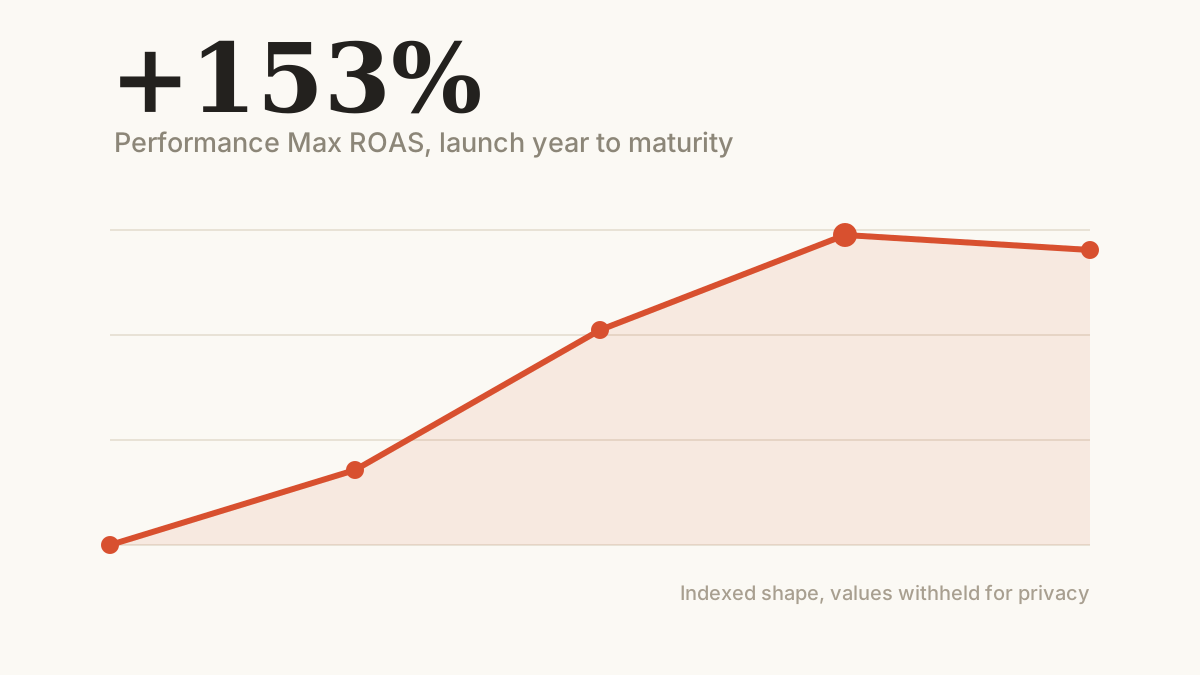
The beauty brand is the clearest maturity curve we have: PMax ROAS climbed period over period as the inputs improved and the system learned, ending +153% above its launch year. Two larger accounts show the same method holding at far greater spend.
a Turn the launch year into a learning year
In year one, PMax on the beauty account ran below 1.5x. Rather than judge it, we used the year to fix the feed and tighten asset groups. By the second year ROAS had risen meaningfully, and it kept climbing through the third and fourth years as the data deepened, finishing +153% above where it started.
The curve is the whole idea: managed PMax gets better with age, because every month of clean conversion data makes the next month's targeting sharper. The accounts that pull the plug at month three never reach the part of the curve where the channel pays.
A weak PMax launch is where the work starts. The ramp is where the ROAS is made.
b Hold the gains while spend scales
Maturity is only impressive if it survives growth. On a large mattress retailer, PMax is one of the heaviest-spend channels in the account and still holds around 5.6x ROAS. On another sizeable account, PMax runs near 8.9x.
The method scales. It holds where the budgets are large and the catalog is deep, which is the harder test, because scale usually erodes efficiency as you push into thinner demand. Holding a strong ROAS while spend grows is what separates a PMax built to compound from one built to coast on its easiest conversions.
The same ramp that matures a small account holds its ROAS when the budget gets serious.
c Stop PMax from eating brand
Left alone, PMax will happily serve on cheap brand queries and report a flattering ROAS that is really just demand you already owned. Brand and search-theme exclusions keep PMax pointed at incremental demand, so the ROAS it reports is closer to growth it created.
Without this step, a great-looking PMax number can be hollow: the channel is taking credit for sales that would have happened anyway, while real prospecting goes unfunded. Separating brand out of PMax is how you tell whether the channel is growing the business or just re-counting it.
A launch-year disappointment that became a profit center.
Managed as a ramp, Performance Max went from a sub-1.5x launch year to +153% higher ROAS at maturity on the beauty account, and held around 5.6x and 8.9x on two much larger accounts. The channel that looked like a dud in month three became one of the strongest lines in the account by year three.
- Performance Max rewards inputs and patience. The ramp, not the launch, is where the ROAS comes from.
Before you judge your PMax.
If your PMax is underperforming, check the feed before the bidding. For a catalog business, feed quality is the single biggest lever, and most underperforming PMax campaigns are starved of clean product data. Then ask whether you have brand exclusions in place; if not, your reported ROAS may be flattered by brand traffic and your real incremental performance is worse than it looks.
Next, look at your asset-group structure. One catch-all group holding every product is the structural mistake we see most; themed groups by line or margin give the system coherent signals and let you steer budget. And resist the urge to bury PMax in negatives and daily edits, which turns it into a worse Search campaign instead of letting it do the one thing it is good at.
Finally, check how long it has run. PMax judged at four weeks is judged in its learning phase. If the structure and inputs are right, give it the quarters it needs before you decide.
How Performance Max gets sabotaged.
The big self-inflicted wound is judging PMax inside its learning phase. A campaign assessed at four weeks is assessed mid-education, and pulling budget then guarantees you never reach the part of the curve where it pays. We hold the line on the ramp window and resist the pressure to call it early.
Then the hollow ROAS. Without brand exclusions, PMax happily serves on cheap brand queries and reports a flattering number that is really demand you already owned. We watch the share of PMax conversions that look like brand, and we exclude brand and obvious search themes so the reported ROAS reflects growth, not re-counting.
Third, the catch-all asset group. One group holding every product gives the system an undifferentiated pile to optimize and no way to steer budget. We structure asset groups by line or margin and watch cost-per-conversion at the group level, so weak groups get fixed instead of dragging the whole campaign down.
And last, over-control. Burying PMax in negatives and daily edits turns it into a worse version of Search and starves the automation of the room it needs. The opposite failure is feed neglect after launch, the feed decaying while everyone watches the campaign. We avoid both: feed maintained, structure clean, and a light hand on the controls.
What we feed the machine.
Performance Max is a black box, but it is not a mystery. It optimizes whatever inputs you give it, so the work is almost entirely about the quality of those inputs. There are four of them, in order of impact, and getting them right is the difference between the launch-year dud and the mature profit center.
The feed comes first, by a wide margin. For any catalog business, the product feed is most of what PMax serves, and the industry consensus matches what we see: feed quality is the single biggest lever. Titles that contain the words people search, complete attributes, correct categories and prices, and clean images do more for PMax than any setting. A thin feed caps performance no matter how good everything else is.
Asset groups come second. One catch-all group holding every product gives the system an undifferentiated pile and no way to steer budget. We split asset groups by product line or margin, so the algorithm learns coherent themes and we can push budget toward what matters. Each group gets its own text, images and, where possible, its own product subset.
Audience signals come third. Signals do not target, they accelerate: telling PMax who your best customers look like helps it learn faster in the early weeks. We build signals from first-party data and high-value segments rather than broad interests, so the head start points in the right direction.
Exclusions come fourth, and they protect the truth. Brand and search-theme exclusions keep PMax from serving on cheap brand queries and reporting a flattering ROAS that is really demand you already owned. Without them, the number lies. With them, PMax is pointed at incremental growth.
Then the fifth input, which is not a setting at all: patience. With the feed, groups, signals and exclusions right, the job is to feed it better inputs and leave it enough room to learn, judging it in quarters. That is the whole method behind the feed-health work that sits underneath it.
A few specifics on each input, because the details are where PMax is won or lost. On titles, the rule is front-load what people search: the product type and its key attributes belong at the start of the title, not the brand or a marketing flourish, because that is what Google matches against and what a shopper scans. A title that reads like an internal SKU is a product that loses auctions it should win.
On asset groups, we resist the urge to over-split. The goal is enough groups to steer budget and feed coherent themes, not a group per product; too many thin groups starve each of the data it needs to learn. We split where the margin or the buyer genuinely differs, and consolidate where they do not, then watch cost-per-conversion at the group level to see which themes earn more budget.
On signals, fresher and first-party beats broad and generic. A customer-match list of recent high-value buyers teaches PMax more in a week than a stack of interest audiences, because it is a real description of who pays, not a guess. We refresh those signals as the customer base grows rather than setting them once and letting them age.
And on the discipline of leaving it alone: leaving it alone is not the same as not watching it. We monitor new-customer share, asset-group efficiency, and where spend is flowing across channels, and we intervene on the inputs, never by burying the campaign in reactive negatives. The intervention is always upstream, in the feed and the signals, because that is the only place a black box listens.
One lever worth setting deliberately is the new-customer goal. Performance Max can be told to value new customers more than existing ones, which stops it harvesting people who would have bought anyway and points it at genuine growth. For a brand that already has strong repeat demand, this is one of the most important settings in the campaign, and one of the most often left on its default.
When we do want to prove a change, we use experiments rather than opinion. Performance Max supports controlled tests, so a feed change, a new asset-group structure, or the new-customer setting can be run as a real A/B split against the existing campaign instead of a before-and-after guess muddied by seasonality. On a black-box channel, a clean experiment is the only honest way to know whether an intervention helped.
Listing-group structure is the Shopping side of the same discipline. Rather than letting every product sit in one undifferentiated group, we segment the products inside PMax so budget and attention can follow margin and performance, the same logic as asset groups, applied to the catalog. It is the difference between PMax spreading spend evenly across products that earn very differently and PMax concentrating where the return is.
Finally, budget pacing. Performance Max rewards stable, sufficient budget, so we scale it in steps rather than lurching, and we watch that it is not capped right as it finds momentum. A campaign that is constantly hitting a budget ceiling never gets to show what the mature ramp can do, so pacing the budget to match the learning is part of letting the curve play out.
What to remember.
Performance Max is a maturity curve, not a switch. A weak launch is where the work starts.
Feed first, structured asset groups, real signals, brand exclusions, then patience and restraint, and a sub-1.5x launch can become a +153% mature channel that holds its ROAS even as spend scales. The advertisers who lose with PMax are almost always the ones who judged it too early or fed it too little.
- PMax ROAS lifted +153% from launch year to maturity
- A sub-1.5x launch year turned into one of the account's strongest channels
- PMax held near 5.6x and 8.9x on much larger accounts
- Brand and search-theme exclusions so reported ROAS reflects real incremental demand