
A disapproved product is paid-for inventory that cannot show.
Shopping and Performance Max do not advertise your website; they advertise your product feed. Every item that is disapproved in Merchant Center is a product that cannot appear, no matter how much budget or how clever a bid strategy sits behind it. It is inventory you are paying to advertise that is invisible to the people searching for it.
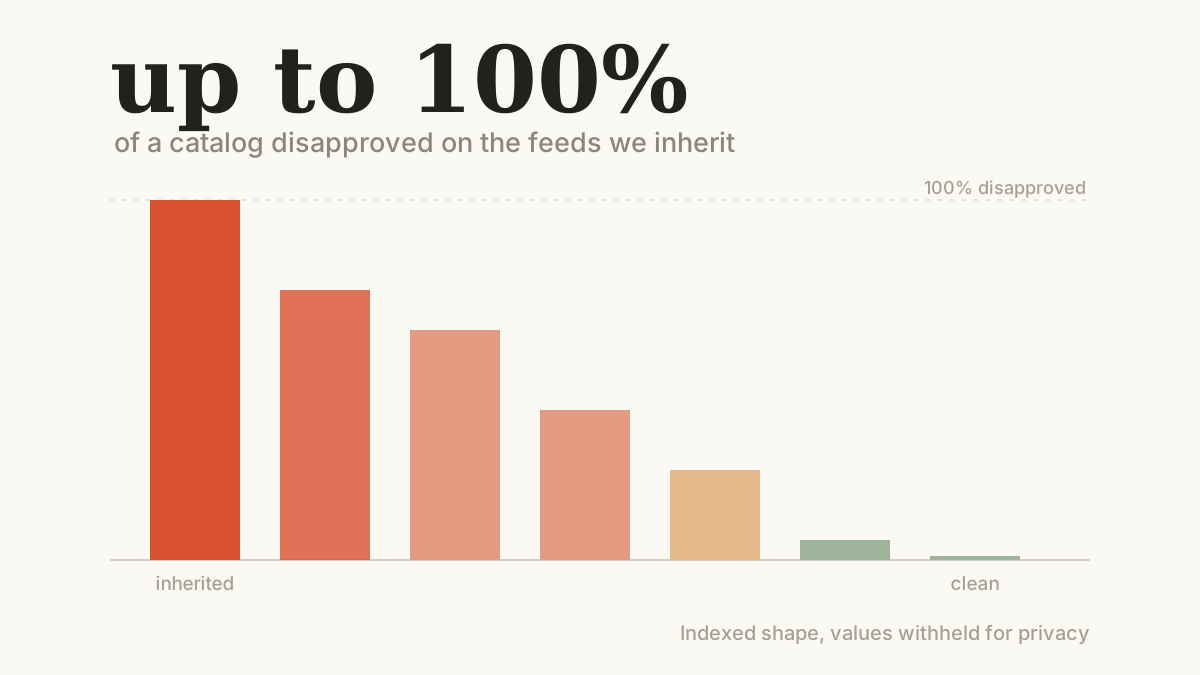
When we audit the feeds of accounts we take over, the disapproval rates are routinely alarming. We have seen everything from a clean near-zero on a well-run catalog to a complete 100% of products disapproved, with plenty of catalogs sitting at a quarter or a third disapproved in between. A brand running Shopping with a third of its catalog disapproved is competing with two-thirds of one hand.
The trap is that feed problems are invisible from the campaign view. The campaigns look fine, the budget spends, and nobody realizes a large slice of the catalog never enters the auction at all. You only see it when you look in Merchant Center, which is the first place we look.
Triage the disapprovals, then keep the feed clean.
Feed health is a triage job before it is an optimization job. We start in Merchant Center, sort the disapprovals by type and by how much spend or potential each affects, and work the highest-impact issues first. Most disapprovals fall into a handful of buckets: missing required attributes, landing-page errors, price or availability mismatches between the feed and the site, and outright policy disapprovals.
Each bucket has a different fix. Missing attributes are a feed-data problem, often solved at the source or with feed rules. Landing-page and price mismatches are usually a sync problem between the store and the feed. Policy disapprovals need the underlying issue resolved, not just a resubmission. Clearing them gets the full catalog eligible, which widens the range of searches the account can compete for, before any bidding changes.
Then the feed has to be kept clean, because it does not stay fixed on its own. This is the ongoing core of our Shopping feed management: catalogs change, prices move, items go out of stock, and Merchant Center finds new reasons to disapprove products every week, so feed health is a standing routine, not a one-time project.
- Audit Merchant Center first
- Triage disapprovals by type and impact
- Keep the feed clean continuously
What feed health actually involves.
The feeds we inherit span the full range, from spotless to almost entirely disapproved. Lining them up shows both how common the problem is and how much eligible inventory is usually being left on the table.
a The range we inherit
Across the catalogs we have taken over, disapproval rates run from a clean near-zero to a full 100%. A well-maintained feed with thousands of products can sit at essentially zero disapprovals; another catalog can have every single item rejected over an account-level policy issue. Many land in the messy middle, a quarter to a third disapproved, where the account is running on a fraction of its inventory.
Seeing that range is the first eye-opener for most brands. The Shopping campaigns looked fine because the spend kept flowing; the disapprovals were invisible until someone opened Merchant Center and counted.
The disapproval rate is the hidden ceiling on Shopping, and it is usually higher than anyone realizes.
b The four buckets, and their fixes
Almost everything we clear falls into four buckets. Missing required attributes (sizes, identifiers, categories) are a data problem, fixed at the feed source or with rules. Landing-page errors mean Google could not load or verify the product page, often a broken URL or a blocked crawler. Price and availability mismatches between feed and site are a sync problem that also risks a trust penalty. Policy disapprovals need the real issue resolved, not a hopeful resubmit.
c Keep it clean
A feed cleaned once does not stay clean. New products arrive without complete data, prices change and fall out of sync, items sell out, and Merchant Center tightens its rules. Without monitoring, disapprovals creep back and the ceiling lowers again while the dashboard still looks healthy.
So the real deliverable is not a one-time cleanup; it is a standing routine that watches disapprovals and fixes them as they appear. That is what keeps a clean catalog feeding both Shopping and Performance Max, where the feed is also the single biggest lever in PMax.
The whole catalog, finally eligible to show.
The outcome of feed health is simple to state and easy to undervalue: the whole catalog becomes eligible to show. A feed taken from heavily disapproved to near-zero is not a vanity metric; it is the difference between competing with your full range and competing with whatever slice happened to be approved.
Because a disapproved product earns nothing, getting it eligible is some of the highest-return work in an ecommerce account, and it is reach you are already paying for. Note: our warehouse currently holds a current-state view of feed health rather than a long before-and-after history, so we frame this as the live disapproval spread we see and the clean state we drive toward, not a single headline delta.
- You cannot bid your way past a product Google will not show. Feed health is the ceiling on everything else in Shopping.
Checking your own feed today.
Open Merchant Center and read your disapproval rate. If a meaningful share of your catalog is disapproved, that is almost certainly your single biggest Shopping opportunity, ahead of any bidding or campaign-type change. Then sort the disapprovals by reason, because the fix depends entirely on the bucket.
Treat it as ongoing, not a project with an end date. Set up a routine that checks disapprovals regularly and fixes them as they appear, so the ceiling you just lifted does not drop back down. A clean feed is not a state you reach once; it is a state you maintain.
How feeds re-break.
A feed cleaned once does not stay clean, so the main thing we watch is creep. New products arrive with incomplete data, a category gets added without identifiers, a bulk edit strips an attribute. Disapprovals drift back up a few products at a time, invisibly, while the campaigns keep looking fine. We monitor the disapproval rate continuously rather than treating the cleanup as a finished project.
Price and availability drift is the next watch point, and the most punishing. When the feed and the site disagree on price or stock, Google does not just disapprove the item; repeated mismatches can cost you trust in Merchant Center and suppress more of the catalog than the few items at fault. We watch feed-to-site sync closely because the penalty is out of proportion to the error.
The catastrophic case is the account-level policy strike. A single policy issue can disapprove an entire catalog at once, taking Shopping and Performance Max to zero overnight. We watch for the early warning signs and resolve the underlying issue rather than resubmitting and hoping, because at the account level the downside is total.
Finally, we watch the difference between approved and competitive. Approval only means a product can show; whether it shows for the right searches depends on titles, types and attributes. A feed at near-zero disapprovals can still underperform if the titles read like internal SKUs, so feed health is the floor, and feed optimization is the work that sits on top of it.
The four fixes, in depth.
Triage is only useful if you know the fix for each bucket, because the same word, "disapproved", hides four completely different problems with four different solutions. Resubmitting and hoping works for none of them.
Missing required attributes are a data problem. Sizes, identifiers (GTIN, MPN, brand), colour, gender, age group, category: when they are missing, Google cannot classify the product and will not show it. The fix lives at the feed source where possible, and where the source cannot be changed, in feed rules that map or supplement the missing fields. This is the biggest bucket and usually the fastest to clear.
Landing-page errors mean Google could not load or verify the product page: a broken URL, a redirect loop, a page blocked to its crawler, or a mismatch between the feed link and the live page. The fix is to repair the URL and make sure the crawler can reach and read the page, because Google will not advertise a product it cannot confirm exists.
Price and availability mismatches are the most punishing. When the feed says one price or in-stock and the site says another, Google does not just disapprove the item; repeated mismatches erode account trust and can suppress far more of the catalog than the items at fault. The fix is a reliable feed-to-site sync so price and stock always agree, which protects the whole account, not just the flagged products.
Policy disapprovals are the highest-stakes. They range from a single restricted product to an account-level enforcement that can take an entire catalog to zero overnight. The fix is to resolve the underlying violation, not to resubmit, and to watch for the early warnings, because at the account level the downside is total. Clearing all four buckets is what gets the full catalog eligible; keeping them clear is the ongoing job that feeds both Shopping and Performance Max.
Past approval, the next layer is the title, because the title does most of the matching. We rewrite titles to lead with what people search, the product type and its defining attributes, rather than internal names or brand-first phrasing. A feed rule can apply that pattern across thousands of products at once, turning a catalog of SKU-style titles into one that actually competes for the queries that matter. Approval gets a product into the auction; the title decides whether it wins.
Supplemental feeds and feed rules are how we fix what the source cannot. When the store platform cannot output a required attribute or a better title, a supplemental feed layered on top fills the gap without touching the underlying catalog. This is also where custom labels go, the tags that let us segment products by margin, seasonality or bestseller status so the bidding can treat a high-margin hero differently from a loss-leader.
The whole thing is monitored, not checked once. We watch the disapproval count on a cadence and treat a sudden spike as an incident, because a spike usually means a feed broke or a policy changed, not that a few products drifted. Catching it the day it happens, rather than the month someone notices Shopping is down, is the difference between a blip and a quarter of lost sales.
And the most dangerous failure gets its own watch: the account-level policy strike. Because a single account-level disapproval can take the entire catalog to zero, we treat policy warnings as urgent and resolve the root cause rather than resubmitting, since at that level there is no partial outage, only on or off.
Past approval and titles, the image is the next quiet lever. Shopping and Performance Max are visual surfaces, so a poor main image loses to a better one even when everything else matches, and additional images give the system more to work with across placements. Lifestyle shots, clean backgrounds, and correct aspect ratios are feed work too, not just photography, and a catalog of weak images caps performance no matter how clean the data is.
Price competitiveness sits in the feed as well. Google can show price-drop and competitive-pricing signals, and it factors how your prices compare into how it serves you, so the feed is not only a data file, it is part of how you stack up against rivals on the same product. Keeping sale prices and promotions flowing correctly into the feed is how you earn those badges instead of leaving them to a competitor with a worse product but a better-maintained feed.
What to remember.
A disapproved product is invisible no matter how good your bidding is, and feed problems hide behind campaigns that look perfectly fine. We inherit catalogs anywhere from a quarter to entirely disapproved.
Audit Merchant Center first, triage the disapprovals by type, get the full catalog eligible, and then keep it clean continuously. It is the ceiling on Shopping and Performance Max, and lifting it is reach you are already paying for.
- Inherited feeds triaged from as much as 100% disapproved toward near-zero
- Disapprovals cleared across all four buckets: attributes, landing pages, prices, policy
- The full catalog made eligible to show, widening the searches the account can win
- Feed health run as a standing routine so the ceiling does not drop again