Performance Max is the campaign type Google pushes hardest, and for good reason: handled well it is one of the most profitable ways to scale an ecommerce account. Handled badly it is a black box that spends your budget across all of Google and leaves you unable to say where the money went. The difference is not luck. It comes down to a few things you control: the product feed, the asset groups, the signals you feed the algorithm, and what you exclude. This is what actually moves the number.
What is Performance Max, really?
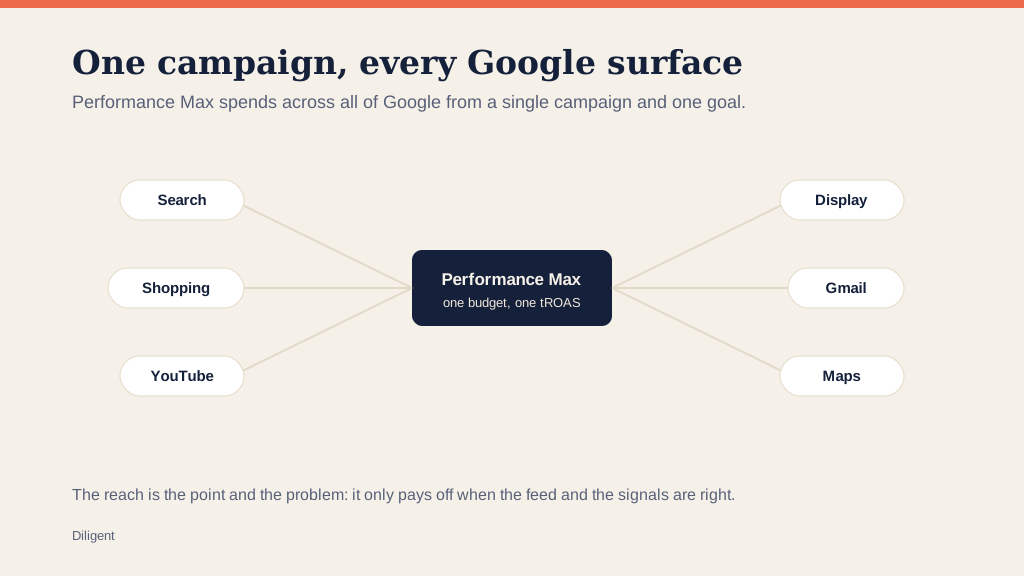
Performance Max is a single campaign that serves across every Google surface at once: Search, Shopping, YouTube, Display, Gmail, Maps and Discover. You give it your conversion goal, a budget, a product feed and a set of creative assets, and Google's automation decides where and to whom to show your ads to hit that goal. For an ecommerce store the Shopping side does most of the heavy lifting, which is why your feed matters more than anything else you can touch. The trade you are making is control for reach: you hand the targeting to the machine, and in return it finds buyers in places you could never have bid into by hand.
What the data says, and the catch
Google reports that advertisers who adopt Performance Max see an average of 27% more conversions or conversion value at a similar CPA or ROAS, even when they already run broad match and Smart Bidding on Search. Adding video helps too: Google found that ecommerce advertisers who included at least one video in their Performance Max campaigns saw around 12% more total conversions.
The catch is what those averages hide. Performance Max wins partly by absorbing demand that was already yours, including brand searches and traffic Search would have converted anyway. In our own accounts, when a Performance Max campaign and a Search campaign are both eligible for the same query, Search usually converts better because the intent is clearer. So the honest read is this: Performance Max is a powerful demand-capture and prospecting engine, but it has to be measured against what your other campaigns would have earned, not just on its own glowing report. A number that includes your own brand is a number that flatters itself.
What a managed ramp actually looks like
Performance Max is a maturity curve, not a switch, and the launch number is the most misleading data point you will ever see from it. On a beauty brand we manage, Performance Max launched below 1.5x ROAS in its first year. Plenty of accounts would have read that as the verdict on the channel and pulled budget. We read it as a learning year: we used it to fix the feed and tighten the asset groups, and ROAS climbed period over period as the data deepened, finishing +153% above where it started, the curve we document in our Performance Max ramp playbook.
The method also holds at scale, which is the harder test, because pushing more budget usually erodes efficiency. On a large mattress and bedding retailer, Performance Max is one of the heaviest-spend channels in the account and still holds around 5.6x ROAS; on another sizeable account it runs near 8.9x. The takeaway is the one most teams miss: a weak launch is where the work starts, not where the channel ends. The accounts that pull the plug at month three never reach the part of the curve where it pays.
The feed is the campaign
If you take one thing from this, take this: in ecommerce, the product feed is the campaign. Performance Max leans on Shopping inventory to find buyers, so a thin or messy feed caps your results no matter how much budget you add. Clean, complete product titles, accurate attributes, correct product types and useful custom labels are what let the algorithm match your products to the right queries. The titles in particular do disproportionate work: front-load the product type and the attributes people actually search, because that is what Google matches against and what a shopper scans. A title that reads like an internal SKU loses auctions it should win. We treat the feed as the first lever, not an afterthought, which is why our feed health work and the standard-shopping-to-PMax migration run feed-first. For the hands-on mechanics, our Google Shopping feed optimization guide walks the titles, attributes and labels that decide what you can win.
Asset groups, signals and the learning period
Inside the campaign, four inputs decide how well the automation performs, and they are worth taking in order.
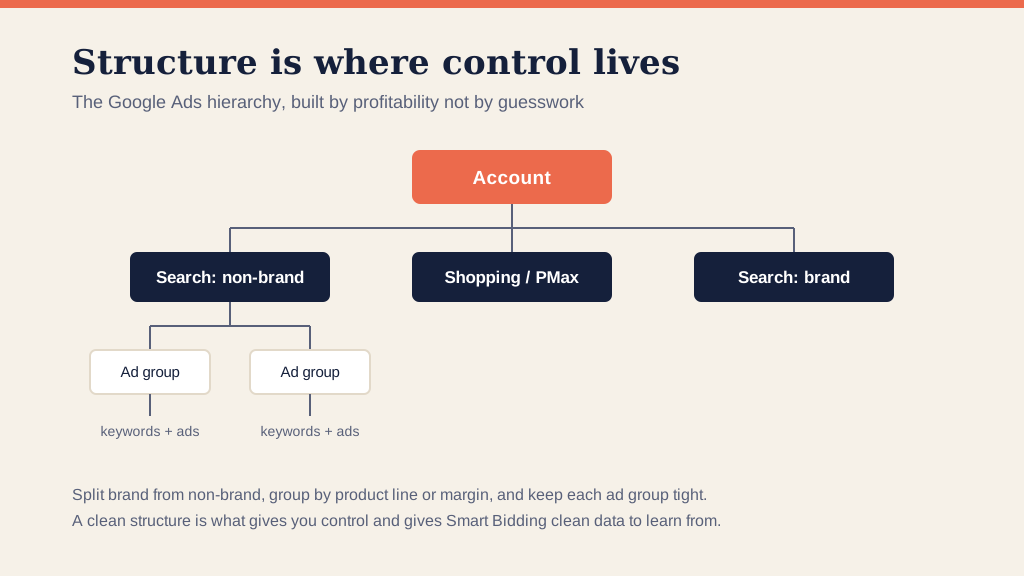
Asset groups should be structured by product line or margin rather than dumped into one catch-all group, so the system learns coherent themes and you can steer budget. Resist the urge to over-split, though: too many thin groups starve each of the data it needs. Split where the buyer or the margin genuinely differs, consolidate where they do not, and watch cost-per-conversion at the group level.
Audience signals accelerate learning rather than restrict it. A customer-match list of recent high-value buyers teaches Performance Max more in a week than a stack of broad interest audiences, because it is a real description of who pays, not a guess. We build signals from first-party data and refresh them as the customer base grows.
The new-customer goal is one of the most important settings in the campaign and one of the most often left on its default. Telling Performance Max to value new customers more than existing ones stops it harvesting people who would have bought anyway and points it at genuine growth, which matters most for a brand with strong repeat demand.
The learning period is the part that needs patience. The first week or two of a Performance Max campaign is the worst it will ever look, and the surest way to ruin one is to panic and change the target before it has learned. Leave it alone long enough to settle, then adjust in small steps.
What to exclude, and why brand is the big one
A raw Performance Max campaign will happily spend on your own brand terms and report them as cheap conversions, which flatters the ROAS and hides what the campaign is really doing for new demand. Apply brand exclusions, account-level negative lists where they help, and brand-list settings so the campaign is judged on incremental sales. Keeping brand and non-brand honest is the same discipline we apply in brand defense: efficient branded traffic should never be used to make acquisition look better than it is. Without this step a great-looking PMax number can be hollow, taking credit for sales that would have happened anyway while real prospecting goes unfunded. Separating brand out is how you tell whether the channel is growing the business or just re-counting it.
How to tell if your Performance Max is underperforming
Before you blame the channel, run the same checks we do on a new account. Is the feed clean, or is a share of the catalog disapproved and a share of titles written for your website instead of the search? For a catalog business the feed is the single biggest lever, and most underperforming campaigns are starved of clean product data. Do you have brand exclusions in place, or is your reported ROAS flattered by brand traffic? Is the whole catalog sitting in one catch-all asset group instead of themed groups you can steer? And how long has it actually run, because a campaign judged at four weeks is judged inside its learning phase. Fix the inputs and give it the quarters it needs before you decide the channel does not work for you.
Proving a change on a black box
Because Performance Max hides so much of what it does, the temptation is to manage it on opinion, and that is a mistake. When we want to know whether a feed change, a new asset-group structure or the new-customer setting actually helped, we run it as a Performance Max experiment, a real split against the existing campaign, rather than a before-and-after that seasonality can muddy. On a channel you cannot see into, a clean experiment is the only honest way to tell a real improvement from a lucky run. It is slower than just making the change and hoping, and it is the difference between learning what works on your account and collecting superstitions.
The other lever most accounts leave on the floor is budget pacing. Performance Max rewards stable, sufficient budget, so we scale it in steps rather than lurching, and we watch that it is not hitting a budget ceiling right as it finds momentum. A campaign capped at the wrong moment never gets to show what the mature ramp can do. The same logic applies inside the campaign through listing-group structure: segmenting the catalog so budget and attention follow margin and performance, instead of spreading spend evenly across products that earn very differently, is the Shopping-side equivalent of structuring asset groups well.
Where Search still beats Performance Max
Performance Max is not a replacement for a well-built Search account. High-intent, non-brand search terms still deserve dedicated Search campaigns where you control the query matching, the negatives and the messaging. The strongest ecommerce accounts we run use both: Search to win the clear-intent queries precisely, and Performance Max to capture and create demand across the rest of Google. Pointing all your budget at one and switching the other off is how you leave money on the table.
How Performance Max gets sabotaged
The failures are self-inflicted far more often than they are the channel's fault. Judging it inside the learning phase and pulling budget at week four guarantees you never reach the payoff. Skipping brand exclusions produces a hollow ROAS built on demand you already owned. A single catch-all asset group gives the system an undifferentiated pile to optimize and no way to steer budget. And the opposite of neglect, burying the campaign in daily negatives and edits, turns it into a worse version of Search and starves the automation of room to learn. The discipline is a light hand on the controls and a heavy hand on the inputs: maintain the feed, structure the groups, set the exclusions, then intervene upstream, not by twitching the campaign.
How we ramp it
Our approach is boring on purpose, because boring is what works. We get the feed clean first, launch with honest conversion values and real audience signals, hold the target steady through learning, layer in exclusions, set the new-customer goal where repeat demand is strong, and only then tighten the ROAS in small steps. When we want to prove a change rather than guess, we run it as a Performance Max experiment, a real split against the existing campaign, instead of a before-and-after muddied by seasonality. The full sequence is in our Performance Max ramp playbook, and it sits inside the wider Google Shopping and PMax work we do as an agency. None of it is exotic. It is the discipline of doing each step in the right order.
Frequently asked questions
How long does Performance Max take to work? Plan in quarters, not weeks. The first week or two is the worst it will look, and managed ramps commonly keep improving period over period as conversion data deepens. Judge it at six to eight weeks at the earliest, and only once the feed, groups, signals and exclusions are right.
Should I run Performance Max and Search at the same time? Yes, for most accounts. Keep dedicated Search for high-intent, non-brand queries you want to control, and let Performance Max capture and create demand across the rest of Google. The best accounts run both rather than choosing.
Why does my Performance Max ROAS look great but profit is flat? Usually missing brand exclusions. The campaign is serving on cheap brand queries and reporting demand you already owned as if it were new. Add brand exclusions and the reported number gets honest, even if it drops.
Do I need video for Performance Max? It helps. Google found ecommerce advertisers who added at least one video saw around 12% more total conversions, and supplying your own video stops the system from auto-generating a weaker one.
How should I structure asset groups? By product line or margin, not as one catch-all group, so the system learns coherent themes and you can steer budget. Resist over-splitting, though: too many thin groups starve each of the data it needs to learn. Split where the buyer or margin genuinely differs, and consolidate where they do not.
What is the new-customer goal, and should I use it? It tells Performance Max to value new customers more than existing ones, which stops it harvesting people who would have bought anyway. For a brand with strong repeat demand it is one of the most important settings in the campaign, and one of the most often left on its default.
The short version
- Performance Max serves across all of Google from one campaign. Google reports about 27% more conversions on average, but the figure includes demand that was already yours, so judge it on incrementality.
- The product feed decides your ceiling. Fix it before you scale spend.
- Structure asset groups, feed real signals, set the new-customer goal, and survive the learning period without flinching.
- Exclude brand so the campaign is measured on new sales, and keep dedicated Search for clear-intent queries. The best accounts run both.