
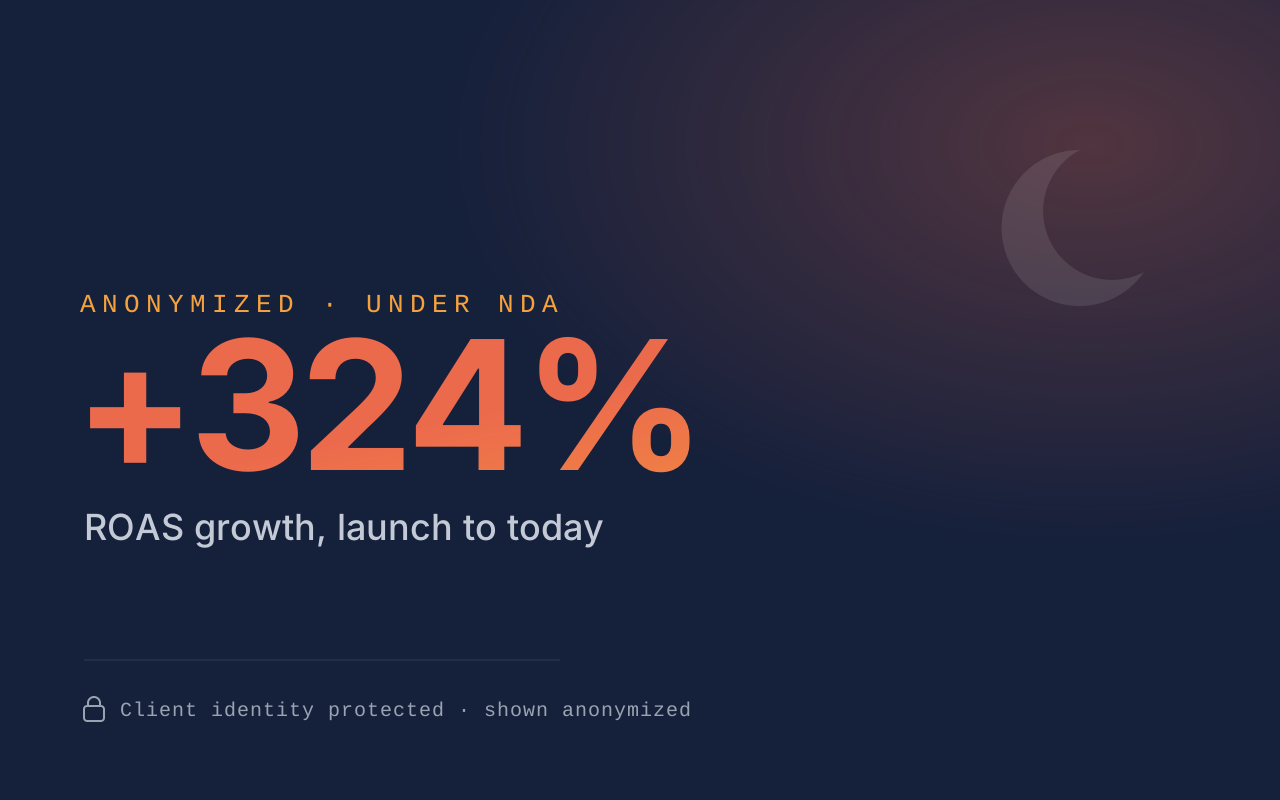
Six years holding a multi-million-dollar account at elite efficiency - through a tracking seam and back to its best sustained ROAS.
This is a Canadian direct-to-consumer sleep brand - mattresses, pillows, bedding - that became one of the most recognized DTC names in the country on the back of digital advertising. We took its Google Ads on in 2020, when the account was already a serious multi-million-dollar program, and we have run it ever since.
What followed was not a straight line. It was six years of holding an elite return at heavy scale, one tracking seam that made a healthy account look like it had collapsed, one deliberate recalibration, and a rebuild to the strongest sustained ROAS the account has produced in our tenure.
The opening position was strong. In 2020 the account returned 9.97x at a multi-million-dollar spend, the high-water mark for the whole category that year. Our job from there was the hard one: hold that kind of efficiency as the surge normalized and spend pushed to its all-time high. In 2021 it held at 9.09x even as spend reached its peak.
Then 2022 looked like a cliff. ROAS appeared to fall to 4.42x while conversion volume jumped about 100%. This was not a business decline, it was a tracking seam: a change in how conversions were counted and valued, partway through the year, that inflated the count and diluted the reported value. The underlying business did not move at that rate, and we flag this year in every analysis so it is not read as a genuine drop.
Once the conversion data was cleaned up in 2023, ROAS recovered to 6.89x on a deliberately lower spend. That was the floor, not the new ceiling. By 2024 and 2025, with the tracking resolved and bidding re-anchored to clean data, ROAS returned to 9.09x and then reached 9.52x, the best sustained efficiency in our time on the account.
The 2026 year-to-date figure is 8.73x, consistent with that restored range. The arc is intact.
- We held the account in a 9-10x ROAS band across the engagement, the seam year aside, at heavy scale.
- After the 2022 tracking seam was resolved, the account rebuilt to its strongest sustained efficiency: 9.52x ROAS in 2025.
Hold an elite return at heavy scale - and read the data correctly when the tracking bends.
When we took the account on in 2020, this was no longer a brand testing a channel. It was an established direct-to-consumer leader spending into the millions every year, in a Canadian mattress category that had become crowded, competitive, and sharply seasonal, with the bulk of demand compressing into the Q4 sales window.
Our mandate was specific. Keep Google Ads as the primary paid growth engine and hold a commercially elite ROAS while spend ran at its highest levels, year after year. That is harder than it sounds: ROAS compression under scale is the default outcome in paid search, and the more spend you push through a finite pool of high-intent queries, the more you are forced into broader match, higher CPCs, and lower-quality traffic.
Holding efficiency at this size is constant structural work: campaign architecture, bid-strategy sequencing, audience layering, feed quality, negative-keyword discipline, and the judgement to know when to press and when to hold.
- Multi-million-dollar spend in a crowded, seasonal category - ROAS had to stay elite, not just positive
- Demand normalizing off a category-wide surge as we took the account on
- A mid-engagement tracking seam that had to be read as measurement, not a media failure
One honest note the data requires us to flag up front. The 2022 year shows a large jump in reported conversion volume alongside a sharp drop in ROAS. This is a tracking seam, not a real inflection in business performance: a change to the conversion-action definition inflated the count while diluting the value per conversion. We treat 2022 as a measurement discontinuity throughout this story and assess true channel performance by bracketing it with the years on either side.
We took the account on in 2020 at a 9.97x return - the strongest efficiency it would show at this scale.
2020 is where our tenure begins, and the account we took on was already performing. It returned 9.97x at a multi-million-dollar spend that year, the highest it would reach at this level of investment, and the baseline every year after would be measured against.
The backdrop helped. With people spending far more time at home, a mattress, long a considered purchase that buyers deferred, became something they had time to research and buy. Category demand surged in a way no bidding strategy can manufacture, and the whole sector felt it.
But a category tailwind only converts to a 9.97x return if the account is positioned to catch it. The infrastructure was mature: seasoned audiences, clean conversion tracking, landing pages and feed quality that could absorb a sudden jump in intent without conversion rates slipping. Our job from day one was not to manufacture that peak, it was to hold it as the surge faded.
That framing matters for everything that follows. The account did not drift upward with the market and then drift back down. The work was to keep efficiency in the 9 to 10x band as demand normalized and spend climbed, which is exactly what 2021 tested.
- 9.97x ROAS at heavy scale - the opening baseline for the engagement.
Spend hit its all-time high in 2021, and the account held near-peak efficiency through every month of it.
2021 was the proof that 2020 was not a one-off. Spend crossed into eight-figure territory for the first time, reaching an all-time high roughly +31% above the prior year. That is the kind of scale jump that typically punishes ROAS: you exhaust your best audiences, bid deeper into marginal inventory, and watch returns compress. It did not happen here.
ROAS landed at 9.09x for the full year. That is a decline from the 9.97x peak in 2020, but only a 9% pullback while spending a third more. The efficiency floor had risen and held.
The natural question is whether 2020 was a one-time surge that inflated the numbers and would never repeat. 2021 answered it. The demand tailwind had largely passed by mid-year, physical retail reopened, and consumer attention fragmented again. None of that caused a meaningful deterioration: the account sustained a 9x-plus ROAS through a full normalized year at maximum scale.
Click volume grew roughly +10% year on year while spend grew +31%, which means average CPC rose materially. That is expected at this scale, cheaper inventory gets consumed first, and pushing further requires bidding into more competitive placements. That ROAS held despite rising CPCs is a sign that conversion rates and order values were absorbing the pressure rather than collapsing under it.
- Spend at all-time high, about +31% above 2020 - ROAS held at 9.09x, only a 9% pullback
- Proved 2020 efficiency was structural, not a one-time demand event
- CPC rose as the account pushed into broader inventory; conversion quality held the return
From a management standpoint 2021 required active discipline. At this spend level a misallocated dollar does not just miss an opportunity, it distorts the bidding signals the algorithms rely on. The work was less about finding new levers and more about protecting the ones already calibrated: audience exclusions, device bid adjustments, geographic budget splits across provinces, and keeping search-term coverage tight as query volume expanded with the broader reach.
The 9.09x ROAS in 2021 is also significant because it matches exactly what the account returned again in 2024, after a difficult two-year period. That is not a coincidence: it reflects a consistent ceiling the account can sustain at high efficiency when tracking is clean, audiences are deep, and spend is at a level the algorithms can optimize against. 2021 established that ceiling empirically.
- Spend scaled to its all-time high in 2021 - ROAS held at 9.09x, confirming 2020 was not an anomaly.
- A full normalized year at maximum scale still returned more than 9x - the efficiency floor had moved up for good.
The numbers bent in 2022, but the business did not.
On paper, 2022 looks like a collapse. Reported conversions roughly 100% higher year on year while reported value fell by about half, and blended ROAS dropped to 4.42x, the lowest of our tenure. Spend kept climbing, up another +14%. If you read the headline ROAS at face value, you would conclude the channel stopped working at exactly the moment more budget went into it.
That conclusion is wrong. What the data is showing is a tracking seam, not a business result.
Partway through 2022 the way conversions were counted and valued changed: the conversion count inflated while the reported value per conversion fell by roughly 70%. Because Google Ads blends all active conversion actions into a single reported total, ROAS, which is just value divided by cost, followed the diluted value down. The change in the measurement, not the business, is what moved.
The proof is in 2023. Once the conversion signal was cleaned up, value per conversion snapped back to its prior level and ROAS recovered to 6.89x without any dramatic change in campaign structure or creative strategy. A real business decline does not reverse that cleanly in one year. A diluted conversion signal does.
The underlying purchase volume in 2022 was almost certainly consistent with the trend from prior years. The mattress market did not crater and the brand did not collapse. The tell is simple, and it is the signature of a measurement change rather than a media failure: the dip showed up across the account at once, not in any single campaign or channel.
- Reported conversions rose about 100% while value per conversion fell roughly 70% - a textbook blended-signal dilution
- The drop hit the whole account at once, the signature of a measurement change
- 2023 recovery to 6.89x ROAS with no structural changes confirms the purchase signal was intact throughout
- A reported dip to 4.42x that reflected signal dilution, not a channel failure - identified, held through, and recovered the next year.
Pulling spend back was the only responsible move after a year of corrupted signal.
2022 ended with a conversion stack that could not be trusted. The mid-year tracking seam had inflated the recorded conversion count, roughly 100% above the prior year, while value collapsed, producing a blended ROAS of 4.42x that reflected neither the true business performance nor a genuine channel deterioration. Walking into 2023 with that signal as the bidding foundation would have been dangerous.
The first priority was not growth, it was an honest audit of what the conversion actions were actually measuring. Which actions fired reliably? Which were duplicates, misfires, or artifacts of the seam? Until that was answered, scaling spend would mean scaling noise.
Spend came down 19% year on year. That was deliberate. Budget was pulled away from campaigns whose performance could not be verified under the cleaner signal and concentrated in the segments with the most legible, historically consistent data. Fewer impressions, tighter targeting, better attribution confidence.
The result was a blended ROAS of 6.89x, lower than the pre-seam years of 8x to 10x, but now reading on a trustworthy signal. That distinction matters. A 6.89x you can act on is worth more than a 4.42x you cannot explain.
- Conversion stack audited, noisy actions removed or isolated
- Spend concentrated in the highest-confidence campaign segments
- Bidding retrained on clean signal, not the 2022 artifact
This kind of recalibration year is uncomfortable. Efficiency looks worse on paper than the peak years, and stakeholders read the ROAS decline from 2021 to 2023 as three years of deterioration. The actual story is one seam year followed by one cleanup year, with the underlying channel performing in line with the long-run trend. Clicks contracted about 11%, tracking the spend reduction and the tighter campaign roster - a managed drawdown, not a competitive squeeze.
- Blended ROAS recovered to 6.89x on a verified conversion signal, up from the seam-distorted 4.42x read in 2022.
- Spend reduced 19% with no loss in measured value efficiency - a controlled reset, not a channel failure.
Spending less than 2021, earning the same ROAS: 9.09x matched on a budget that was 20% smaller.
2024 is the year the structural work from 2022 and 2023 paid off in full. Spend fell another 14% from the 2023 level, a deliberate pull-back, not a retreat, and ROAS climbed from 6.89x to 9.09x. That is a +32% efficiency gain in a single year, on a budget that was already shrinking.
The number that makes this year the proof point is not the ROAS on its own. It is that 9.09x is exactly what the account returned in 2021, the year of peak all-time spend. The account is now generating the same return on ad spend on a budget roughly 20% smaller than that peak. That gap is structural, not cyclical.
The mechanics are visible in the click data. Clicks fell 28% year on year, but conversions rose +15%. That combination, fewer clicks and more conversions, is the signature of a cleaner campaign structure: the account stopped paying for traffic that looked useful but did not buy. Cost per conversion came down roughly 25%.
The 2022 seam had left the account in an ambiguous state for most of 2023, with the bidding fed unreliable signals and the campaign mix built around corrupted conversion data. 2024 is the first full year where every bid, every budget allocation, and every creative decision was made against trustworthy numbers.
- ROAS back to 9.09x - matching 2021 peak-spend efficiency on 20% less budget
- Conversions up +15% while clicks fell 28% - fewer, better-qualified sessions
- Cost per conversion down about 25% year on year, the structural gain made concrete
Pulling spend back does not improve efficiency on its own; plenty of accounts cut budget and get nowhere. But if the underlying structure is sound, a leaner budget forces the algorithm to concentrate on what converts. The 2022 to 2023 rebuild created that sound structure. 2024 is where the algorithm had room to prove it.
- ROAS recovered to 9.09x in 2024 - identical to the 2021 peak-spend benchmark, on a budget 20% smaller.
- Conversions grew +15% while clicks fell 28%, cutting cost per conversion by roughly 25% year on year.
2025 is the year the account became larger and more efficient at the same time.
Every mature paid-search account faces the same structural tension: as spend scales up, ROAS tends to compress. You exhaust the high-intent, low-cost queries first, then push into broader, more expensive territory to find incremental volume. For most of this account's history that trade-off was visible and real.
2025 broke the pattern. Spend grew +12% versus 2024, a meaningful increase at this account size, not a rounding error. Revenue grew +17%. And ROAS landed at 9.52x, up from 9.09x the prior year. Both levers moved in the right direction at once.
To put the figure in context: 9.52x is the highest sustained return the account has produced in our six years on it, and it came at heavy scale in a mature, competitive category, not on a thin early-stage budget. That makes it a structurally different achievement from a high return on a small account.
- ROAS 9.52x - highest at meaningful scale in account history
- Revenue grew +17% while spend grew only +12%
- Clicks grew +14% with efficiency preserved - not a volume sacrifice
The mechanism was structural, not cyclical. The 2022 seam had inflated conversion counts artificially, and 2023 to 2024 was spent rebuilding clean signal: re-anchoring smart bidding on verified purchase data, tightening segmentation, and letting the bidding retrain on a trustworthy baseline. By 2025 that work had fully compounded - the algorithms were bidding on accurate data with two-plus years of clean history, and the account structure reflected the real demand shape of the Canadian market.
Click volume grew +14% year on year, which matters because it confirms the efficiency gain was not achieved by pulling back on reach. The account bought more traffic, converted it at a higher rate, and earned more revenue per dollar. That is the payoff of structural work compounding, not a lucky run in the market.
2025 also validates the decision made in 2023 to reset spend rather than defend volume through the recalibration. A weaker agency holds spend to protect the relationship and papers over the tracking problem. The right call was to take the short-term hit, fix the foundation, and let performance recover on honest numbers. The 2025 ROAS is the return on that discipline.
- Revenue grew +17% on +12% more spend - efficiency and scale moving together at full account maturity.
- ROAS of 9.52x is the highest sustained return in the account's history at meaningful media investment.
Through mid-year, efficiency is tracking exactly where 2025 left it.
With roughly the first half of the year recorded, 2026 is producing a ROAS of 8.73x. That sits just under 2025's 9.52x full-year result, which is exactly what a healthy partial-year read should look like: stronger early in the year, with no real deterioration underneath.
The more important observation is what is not happening. There is no efficiency regression. After the 2022 seam obscured performance and the 2023 reset forced a deliberate recalibration, the account rebuilt cleanly to 9.09x in 2024 and improved again in 2025. The 2026 read does not break that trend.
Spend pacing is steady too. 2025 ran at a healthy multi-million-dollar cost level, and 2026 is tracking a similar annual envelope. The campaigns are not spending defensively or erratically; the account is running at its normal pace.
A partial year cannot be read as a conclusion. The Q4 sales period historically drives a disproportionate share of both spend and conversion value in the mattress category, so the full-year figure will be shaped heavily by the back half. What 2026 to date confirms is that the account enters that period in the same condition it was in twelve months ago: efficient, stable, and structurally sound.
- 2026 to date ROAS: 8.73x - within rounding distance of the 2025 full-year result, with the high-volume Q4 season still ahead.
- Six years in, the account is pacing in line with its best sustained efficiency, with no regression after the seam.
Six years measured: elite efficiency held, then rebuilt to its best.
The honest headline here is not a growth multiple, it's durability. Across six years on a multi-million-dollar account, ROAS held in a 9-10x band, the seam year aside, and finished at 9.52x in 2025, the strongest sustained efficiency in our tenure. Holding that kind of return at that kind of scale is the hard part.
- ROAS held in a 9 to 10x band across the engagement, 2020 to 2025
- Best sustained efficiency reached in 2025 at 9.52x, on a leaner budget than the 2021 peak
- +17% revenue growth in 2025 vs 2024, on higher spend and higher ROAS
Every year in the true arc held a strong return. 2020 opened at 9.97x as the category surged; 2021 held 9.09x at all-time-high spend; the deliberate 2023 reset still returned 6.89x on a clean signal; and 2024 restored 9.09x on a budget about 20% smaller than the 2021 peak.
The one exception needs an asterisk. The 2022 blended ROAS of 4.42x reflects a conversion-tracking seam, not a real dip: a change in how conversions were counted and valued, partway through the year, that inflated the count while diluting the value. The 2023 recovery to 6.89x and the 2024 return to 9.09x confirm the read.
The 2025 result is the strongest sustained year in our time on the account: 9.52x ROAS with revenue up +17% year on year. It is not a spike. The 2020 high of 9.97x was a demand-surge peak that was always going to compress; the 2025 number is structural efficiency, built through audience depth, campaign architecture, and a clean bidding signal. 2026 to date is running at 8.73x, so the gains are holding rather than pulling forward.
- ROAS held in a 9-10x band across the engagement and finished at a best-sustained 9.52x in 2025.
- Every year in the true arc returned strongly, the 2022 tracking seam aside - including the 2023 reset at 6.89x.
Efficiency at scale is a discipline, not a phase - if you manage the signal.
Most advertisers treat ROAS and spend as a seesaw: push one up and the other comes down. This account is a six-year argument that, at heavy scale, you can hold an elite return steady if you treat the conversion signal as infrastructure, not an afterthought. The account held a 9-10x ROAS across the engagement and rebuilt to its best after a measurement shock.
The first lesson is signal discipline. Every strong year, 2020 at 9.97x, 2021 at 9.09x, 2024 and 2025 at 9.09x and 9.52x, came from a period where the conversion action was stable, well-defined, and continuous. The bidding had something real to optimize against. When the signal broke in 2022, no amount of creative or bidding strategy could have flattered the reported number.
The second is reading the data honestly. The 2022 numbers show conversion volume up about 100% while ROAS fell from 9.09x to 4.42x. That is not a business crisis, it's a tracking seam. An agency that read it as a strategy failure would have cut spend, restructured campaigns, and blamed the market. Knowing what the data actually means is worth as much as the data itself: the right response was to understand the seam, hold the account steady, and plan the recalibration.
And the last one is what a recalibration year actually is. 2023 looks like a retreat on the surface, spend pulled back 19% and ROAS at 6.89x, below the account's best. But 2023 was the year the conversion signal was cleaned up, the campaigns were rebuilt around one clean action, and the bidding was retrained on reliable data. Without that work, 2024 at 9.09x and 2025 at 9.52x do not happen. A year that feels like a step back is sometimes the investment that makes the next peak possible. That full-stack discipline, the analytics and the media run as one system, is exactly what we build for ecommerce brands.
- A 9 to 10x ROAS held across six years at heavy scale - efficiency at scale is a discipline
- The 2022 conversion-action change was a tracking seam, not a strategy failure - reading data correctly is a competitive advantage
- The 2023 recalibration felt like retreat; it set up the two strongest ROAS years in our tenure
- Took the account on in 2020 already at multi-million-dollar scale and held its efficiency
- 2020 opening position: 9.97x ROAS as category demand surged
- 2021 all-time-high spend held at 9.09x ROAS as the demand surge normalized
- 2022 tracking seam identified (a measurement change, not a performance event) and held through without chasing an unreal number
- 2023 reset: conversion signal cleaned, bidding re-anchored, ROAS at 6.89x on trustworthy data
- 2024 efficiency restored to 9.09x on a budget about 20% leaner than the 2021 peak
- 2025 best sustained efficiency: 9.52x ROAS with revenue up +17% year on year
- Value-based and Target ROAS bidding maintained through the seam and the rebuild
- Google Ads and the analytics and conversion-tracking stack run as one system