
They came to us to launch from zero.
A leading North American sleep brand came to us to launch paid advertising on Google. They are a serious direct-to-consumer player in the mattress and bedding space, with a strong product line and a growing retail footprint of physical stores across the country.
What made this engagement different was the starting point: there was nothing to optimize. The Google Ads account was brand new, with no conversions, no audiences, and no historical data for the bidding algorithms to lean on.
The website itself was not even live yet when we started building.
For most agencies that is a slow, cautious start. We saw it as the chance to build the whole thing correctly from the first day, with no bad habits to undo and no broken tracking to inherit.
A cold start in a crowded, seasonal market.
A cold-start launch in a competitive market is hard for one simple reason: paid advertising runs on data, and on day one there is none. No conversion history, no audiences to remarket to, no signal for smart bidding to optimize toward.
On top of that, the mattress and bedding category in Canada is crowded and seasonal, with the bulk of the year's demand compressing into the Q4 sales period. We could not afford a slow ramp that missed the first big season.
So we set ourselves a hard target: have the entire measurement stack and the advertising engine built, approved, and live the moment the website launched, not days or weeks after. We focused on three things:
- Full-funnel conversion tracking, built before launch
- A product feed ready to submit the instant the site went live
- A value-based campaign structure that could learn from the first impression
2023 - Launch and the tracking foundation
Everything started with measurement. Before a single ad ran, we built the brand's entire analytics and conversion-tracking stack ourselves: GA4, Google Tag Manager, and the full conversion funnel.
Not a single purchase action bolted on later, but a proper macro-and-micro funnel from day one: Purchase as the headline action, plus Add to Cart and Begin Checkout as the micro steps that tell you where people fall out and feed the remarketing audiences.
We also built every remarketing audience in advance, and had all ad copy written and client-approved before launch. Nothing was improvised on launch day.
The point of all this micro tracking is not vanity reporting: each micro event becomes a segmentation signal, so the remarketing could be tailored to where someone actually was in the funnel. A cart abandoner gets a different message than someone who only viewed a product, and the smart bidding has richer signal to optimize against from the very first conversions.
Because the account had no history, manual and value-based controls had to do the work that historical data normally does. We leaned on the clean event layer to compensate: with macro and micro conversions firing correctly from day one, Maximize Conversion Value had something real to learn from far sooner than a typical cold start, which is usually starved of signal for weeks.
The launch itself is the part worth pointing out. We had the product feed prepared in advance, every title, description, image, and field complete, so the moment the website went live we submitted it to Google straight away.
Performance Max and the campaigns were live and generating impressions in under twenty four hours of the site launching. Anyone who has launched Shopping knows feeds and approvals usually cost you days before you can serve a single product ad. We launched same-day.

From the start the account ran an alpha-beta structure with brand and non-brand fully split, Search and Performance Max separated, and Maximize Conversion Value as the bidding foundation from the first day.
The launch months were exactly what a cold start looks like: the account gathered its first conversions and trained its audiences, with efficiency still finding its feet while the bidding algorithms learned. The trajectory was set, the foundation was clean, and everything after this was built on top of it.
- A full measurement stack and value-based structure built from zero, live within 24 hours of site launch, the launch quarter ROAS at 1.12 as the account gathered its first signal.
We run the measurement, not just the media.
This account is a full analytics and conversion-tracking engagement, not only media buying, and that is a real part of why it performs. We own the entire measurement stack: GA4, Google Tag Manager, the conversion funnel, and the audiences, all built and maintained by us.
The part most ecommerce accounts never do is the offline side. This brand runs several physical stores across the country, and we set up offline conversion tracking to measure store visits and in-store sales back to the advertising.
That means the bidding is not optimizing against online purchases alone. It sees the fuller picture of value the ads create, online and in-store.
A shopper who clicks an ad and then buys a mattress in a showroom is exactly the kind of conversion most accounts are blind to, and here it is measured and fed straight back into the optimization.
Most agencies optimize to the online checkout and miss every sale that finishes in a store. For a brand with a real retail footprint that is not a rounding error, it is a meaningful slice of the revenue the ads actually drive, and leaving it untracked would understate the return and starve the bidding of its best signal.
None of this is a bolt-on. Because we built the measurement before the media, every optimization since has run on signal we trust: the events fire correctly, the values are right, and the offline conversions reconcile back to the campaigns.
When an agency inherits someone else's tracking it spends months untangling it. Here there was nothing to untangle, because we built it clean and we have kept it clean, and that is time we spent optimizing instead of repairing.
That complete signal is a big part of why the return on ad spend has climbed as cleanly as it has.
2024 - The breakout
2024 is when all of the foundational work started paying off. Through late 2023 and into early 2024 we were scaling the prospecting campaigns, opening them up, building out negative keywords, training the bidding strategies, and nurturing the account day by day.
By the second quarter of 2024 it all came together: return on ad spend stepped up sharply, climbing +156% from Q1 to Q2, and the account moved from launch-ramp to a genuinely profitable engine.

Search was the engine of that breakout, and the alpha-beta structure is what made it scalable. Broad, exploratory prospecting campaigns surface new converting search terms.
The winners graduate into tightly controlled exact-match campaigns that get the budget, and everything irrelevant flows into an ever-growing negative list.
Run that loop daily for months and the account compounds: spend concentrates on terms that convert, wasted spend keeps falling, and Quality Score climbs.
As the structure matured and the negatives tightened, Search return on ad spend climbed +193% across the year, 2023 to 2024, and became the clear workhorse of the account.
Performance Max ran strongly alongside it from launch, feeding off the same clean conversion signal and the product feed we had maintained since day one. The early Display and Video tests that did not pull their weight were pruned back so budget concentrated on what converted. Cutting what does not work matters as much as scaling what does.
The bigger story of 2024 is basket quality. As the account exited its learning period the average order value normalized upward from the launch ramp into a healthy, stable range, so we were not just buying more conversions, we were buying better ones.
The account closed the year on its seasonal Q4 volume peak, the first full demonstration of the pattern that would define the relationship: build through the year, then convert hard in the Q4 sales window.
- The breakout quarter: ROAS jumped +156% from Q1 to Q2 2024 as the account exited learning.
- Search ROAS climbed +193% across the year, 2023 to 2024, to become the account workhorse.
2025 - Scaling and the Q3 prospecting push
2025 was the year we scaled hardest, and it is the most interesting chapter in the account. Return on ad spend rose again year on year, up +12%, while we grew spend +56% and revenue +75%.
But the part worth understanding is what we did in the third quarter. Q3 is the build-up to the Q4 sales season: Black Friday, Cyber Monday, Boxing Day, the period when this category does the bulk of its business.
So in Q3 we deliberately pushed budget hard into Search and Performance Max prospecting, not brand, not Demand Gen, but true performance prospecting, to build large, well-qualified audiences ahead of the season.
There is a reason the lever is prospecting and not brand or Demand Gen. Brand demand is already captured: those shoppers convert whenever they search, so spending harder there in Q3 just pulls forward sales we would win anyway.
The job in Q3 is different. It is to widen the top of the funnel with genuinely new audiences the season can convert, which is exactly what performance prospecting at scale does.
That push compressed return on ad spend in Q3 by design, because prospecting at scale always costs efficiency in the short term. The important part: even at the peak of the push, we held the return on ad spend the client wanted. At no point was the dip a concern, it was a planned investment.

The mechanics matter here. Pushing prospecting hard means accepting more top-of-funnel, less-qualified traffic in the short term, which is why efficiency compresses during the push.
But every one of those interactions becomes audience data, and that data is what the bidding leans on when the season arrives.
Holding the target return on ad spend through a deliberate push is the hard part, and it is daily work, not a one-time budget decision. Pushing volume drags efficiency down, so every day we rebalanced budgets and bids to keep the compression inside the client's target band, scaling exactly as hard as the target would allow and no harder. That is the kind of hands-on Google Ads management a deliberate push depends on.
Then Q4 paid it back. The audiences we built in the push converted through the sales season, and Q4 return on ad spend recovered +41% quarter on quarter, straight past where it had been, into the strongest quarter of the year.
This was also the year we added standard Shopping as a focused, high-return complement alongside Performance Max, and layered Target ROAS bidding onto it, maturing the account from pure value-based bidding toward explicit return targets.
Standard Shopping gives back something Performance Max hides, visibility into the exact search terms and products driving sales, so we could keep optimizing the feed and the negatives with full sight of what was working.
- A deliberate Q3 prospecting push, held at the client's target ROAS at the biggest spend quarter yet, then Q4 ROAS recovered +41% to a record quarter.
- Full-year revenue +75% and ROAS +12% year on year, while spend grew +56%, efficiency rising as we scaled.
2026 - Best-ever efficiency
The pattern compounded. Into 2026 the account reached its best efficiency yet: return on ad spend climbed +12% year to date against the same window the year before, with revenue +24% and purchases +38%, the strongest numbers in the account's history.
Search, the workhorse from the beginning, is now returning 6.0x its cost, while the standard Shopping complement runs at 7.26x, the single most efficient channel in the account, and the whole thing runs on mature value-and-ROAS-based bidding.
What is different now is predictability. In the launch year every week was a question, today the account behaves: the bidding holds its targets through the seasonal swings, and the forecasting is tight enough that we can plan the Q3 push and the Q4 payback in advance rather than react to them.
Three years of compounding is the quiet engine underneath the numbers. The negative-keyword lists are deep, the converting-term lists are mature, and the audience data from every prospecting push has accumulated into a signal most launch accounts will not have for years.
The bidding now runs on Maximize Conversion Value with Target ROAS layered on top, so it optimizes to explicit return targets rather than raw volume, and it holds them through the seasonal swings instead of drifting.
The channel mix has settled into its most efficient shape yet. Search carries the intent-heavy demand at the account's best-ever returns, and Performance Max covers the broader prospecting and the feed.
The standard Shopping complement runs at the highest return of any channel, because it shows us exactly which products and search terms are paying, so we keep trimming the feed and the negatives against real evidence.

What started as a cold launch with no data is now a profitable, predictable engine that gets more efficient as it scales, year after year.
- Best-ever efficiency: ROAS +12% year to date against the same window last year, with revenue +24% and purchases +38%.
- Search returning 6.0x its cost and standard Shopping at 7.26x, the account's most efficient channels ever.
An account that got better as it got bigger.
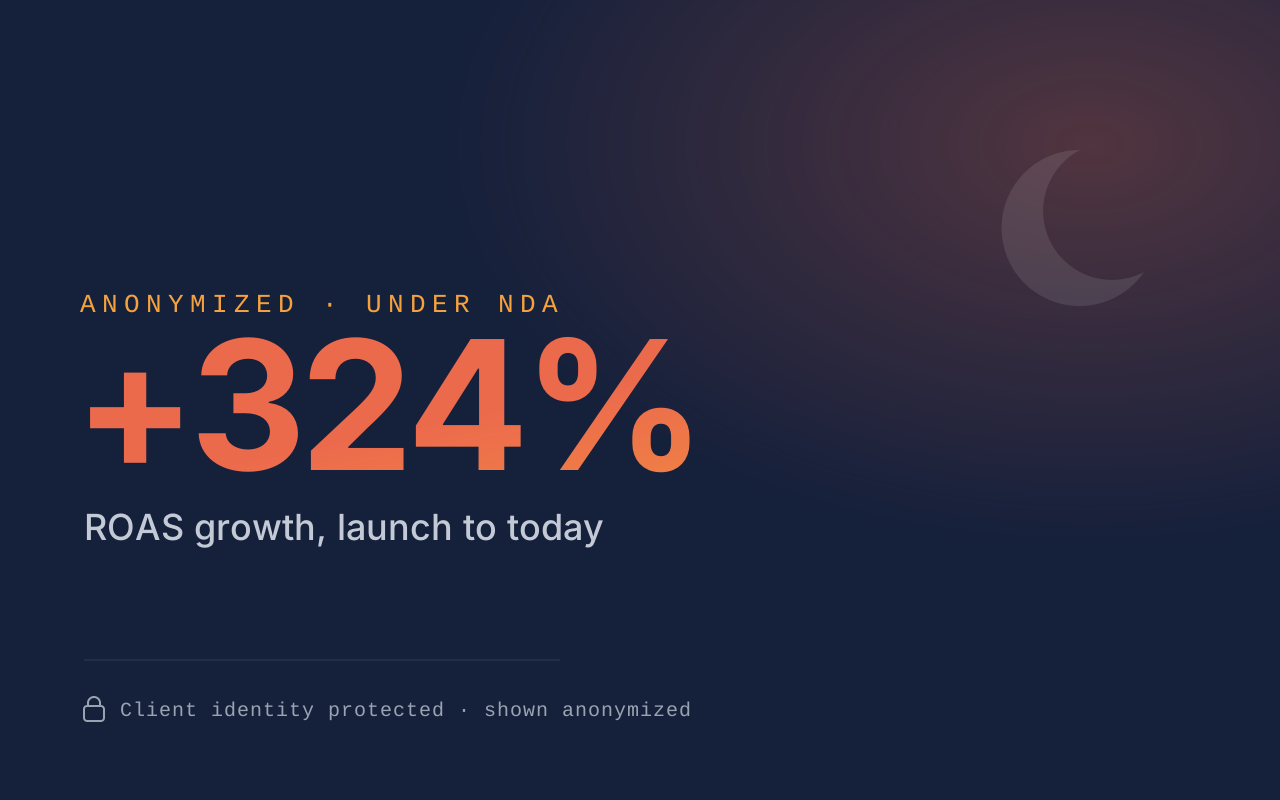
This is one continuous story of an account that got better as it got bigger. From a cold start with no data, return on ad spend climbed every single year, launch to 2024 to 2025 to 2026, up +324% in total, while spend scaled +390%.
That is the hard part: efficiency usually erodes when you scale, and here it did the opposite.
The quality of the growth shows in the channels. Search return on ad spend climbed from 1.19x at launch to 6.0x by 2026, a +406% rise, and became the workhorse. Performance Max was strong from the first months.
Standard Shopping, added as a deliberate complement in 2025, became the most efficient channel in the account at 7.26x. The early Display and Video waste was pruned.
Average order value normalized upward off the launch ramp and held in a healthy range as volume grew, up +16% year on year into 2025, so the account was buying better orders, not just more of them.
The differentiator is simple to say and hard to do: we made the account more efficient every year, its return on ad spend up +324%, while spend grew +390%. Most accounts trade efficiency for scale, this one bought both, because the foundation was clean and the day-to-day management never let up.
And the seasonal discipline is the repeatable engine: each year we push performance prospecting in Q3 to build audiences, hold the client's target return on ad spend through the push, then convert that audience hard in the Q4 sales season. The deliberate trough is not a wobble, it is the investment that makes the peak.

Build it right, and the numbers follow.
The lesson here is the one we trust most: when you get to start clean, you build it right, and the numbers follow. Tracking before spending. Structure before scale.
A product feed ready before the website is even live, so you are serving ads the same day, not a week later.
We love to get our hands dirty and do the grunt work: the negatives added every day, the audiences nurtured, the bidding trained patiently through its learning weeks. None of it is flashy. All of it compounds.
That is what this account is. It is not one clever trick. It is a clean foundation and relentless day-to-day management, turning a cold start into an engine that gets more efficient every year it grows. At our agency we specialize in exactly this for ecommerce brands: the full stack from analytics and tracking through to the media that scales on top of it.
- Full-funnel GA4 and GTM tracking built pre-launch
- Remarketing audiences built from zero
- Product feed ready for same-day launch
- Alpha-beta structure, brand and non-brand split
- Search and Performance Max scaling
- Standard Shopping added as high-ROAS complement
- Value-based then Target ROAS bidding
- Offline store-visit and in-store sales tracking
- Seasonal Q3-prospecting-into-Q4 engine