
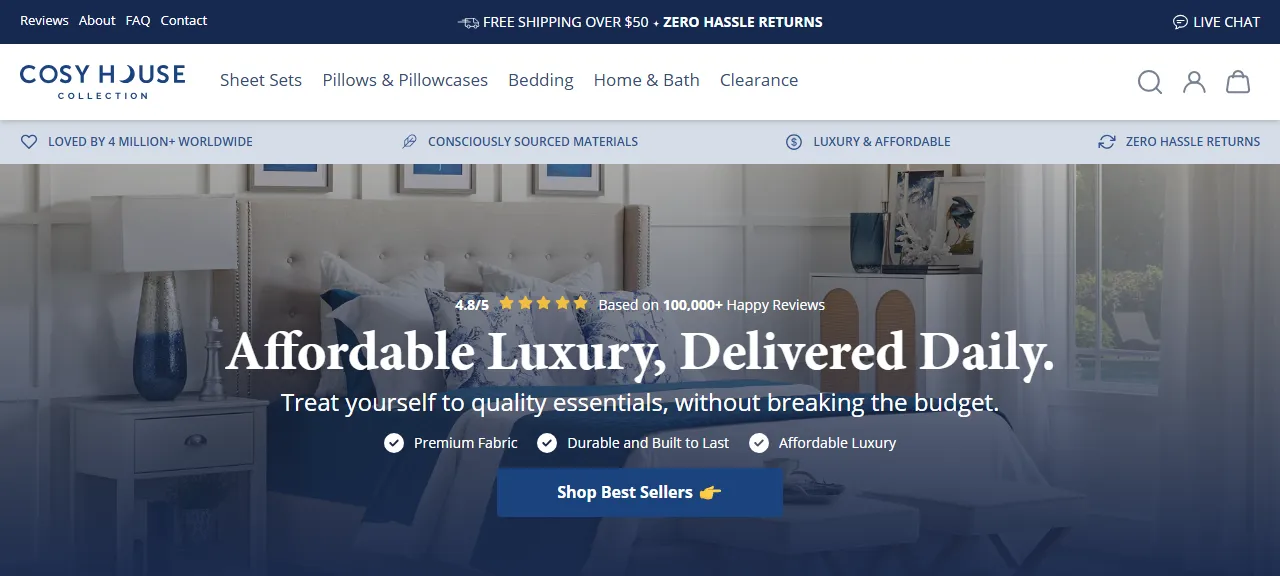
A loved brand, running on one channel.
Cosy House Collection has two goals, and they are honest ones: to make genuinely comfortable bedding, and to sell it at a price normal people can afford. Their bamboo sheets, pillows, pillowcases and mattress protectors have found their way into millions of homes, and the brand had real affection behind it.
But when they came to us, all of that demand was being funnelled through a single channel. The account ran Shopping campaigns and almost nothing else, on Google, with Bing untouched. For a catalogue this broad, that left most of the searches people actually make, and most of the funnel, completely unworked.
The ask was clear. They wanted to launch the rest of the Google and Bing campaign types, and to scale the Shopping campaigns they already had, without letting the efficiency slip as the spend grew.
One campaign type cannot carry a whole catalogue.
Shopping is a great channel for a product brand, but on its own it only catches people who are already searching for the product. It does not work the brand searches, the category searches, the people halfway down the funnel, or the ones who visited once and left without buying.
The catalogue made it more demanding, not less. Sheets, pillows, pillowcases and mattress protectors each behave differently, with their own search intent, their own margins and their own best-selling variants. Lumping them together was never going to scale cleanly.
And there was the efficiency line we could not cross. It is easy to buy more sales by simply spending more, but that was not the brief. The brief was to grow the volume and hold, or improve, the return on every dollar at the same time.
Build the full funnel, on two channels, and measure it honestly.
a A research layer that feeds a converting layer
We built out Search the way it should be built, as two layers that feed each other. A research layer ran broader keywords to discover the exact searches people were making, and a converting layer concentrated the budget and the aggressive bids on the terms that proved they sold.
Every category got its own structure, split by brand and non-brand: Sheets, Pillows, Pillowcases, Mattress Protectors, each able to carry its own bids, its own copy and its own best variants instead of being averaged together. This is what disciplined Google Ads management actually runs on.
The loop only works if you actually run it. We went through the search terms on a tight cadence, promoting the queries that converted up into the converting layer and adding the irrelevant ones as negatives before they could waste another dollar. Over the weeks that pushed more and more of the budget onto the exact searches we already knew turned into sales, and starved the ones that never would.
A search account where every category, brand and non-brand, could be bid and optimised on its own merits.
b Scaling the Shopping they already had
We did not throw away the channel that was working. We took the existing Shopping campaigns, cleaned up the structure, and split them so the strong categories could scale without dragging the weaker ones along, running both standard and Smart Shopping where each fit best.
A Shopping campaign is only ever as good as the feed underneath it, so we worked the product data itself: clearer titles, the right attributes, the variants people actually searched for. The better the feed described a sheet set, the more often Google matched it to the right query instead of guessing, and the less we paid for the wrong clicks.
Sheets were the engine of the catalogue, so they got the room to grow, while smaller lines like pillowcases and mattress protectors were kept efficient rather than forced. Shopping went from the whole account to one strong pillar of a much wider one.
Shopping kept its strength and got room to scale, now as one pillar of a full account rather than the whole of it.
c Going local where the demand was
The data showed the demand was not spread evenly across the country, so we stopped treating it as if it were. We carved out dedicated local campaigns for the states that pulled their weight, California, Florida, New York, Texas, Massachusetts, Michigan, so the budget and the bids could follow the buyers.
Running the strongest geographies as their own campaigns meant we could be aggressive where it paid and restrained where it did not, instead of setting one blunt national bid for everyone.
State-level campaigns let the budget chase the buyers, instead of one blunt national bid.
d A second channel, and it pulled ahead
With the structure proven on Google, we stood up the whole thing again on Bing, now Microsoft Ads, a channel the account had simply never used. We mirrored the same research-to-converting logic and the same category splits, so nothing had to be reinvented.
Bing is often dismissed as the small second screen, but for this audience it outperformed. Across the engagement Bing returned about 2.47x on spend against Google's 2.35x, at a lower cost per sale, on a smaller budget. A whole profitable channel that had been sitting unused.
Bing returned about 2.47x against Google's 2.35x, a profitable second channel that had been sitting unused.
e Tracking, the full path, and bringing people back
None of the optimisation is trustworthy without honest measurement, so we set up the conversion tracking properly in Google Analytics and ran a weekly QA on the tracking codes to keep it clean. That let us see the whole picture, not just the last click.
When we looked at the full conversion path rather than the final touch, Google's contribution was about 21% larger than last-click alone gave it credit for, because so many buyers researched on one channel and came back through another. We used that to stop under-valuing the campaigns that started the journey.
Then we built the layer that catches the people who do not buy first time. We segmented the audiences by intent, cart abandoners, recent website visitors, and similar-buyer lists modelled on the customers we already had, and worked each one differently across search and display.
Display remarketing ran by product category, so the creative matched what someone had actually looked at, and we added upsell paths that nudged a pillow buyer toward the matching sheets. The visitor who left a full cart was no longer a lost sale, just one we had another good chance at.
Measured to the full path, not the last click, with remarketing built to bring the almost-buyers back.
f Bidding on lifetime value, and growing the catalogue
Not every sale is worth the same to the business. We ran a lifetime-value analysis to see which products and which customers actually came back, so we could afford to bid harder for the buyers who were worth more than one order, rather than always chasing the cheapest possible first sale.
The catalogue did not stand still either. As Cosy House launched new products, we folded them into the structure as they arrived, giving each its own research and converting home, so a new line never had to start life in a cold, unstructured campaign.
And we kept the spending deliberate. We forecast the budget and paced it against the targets, so scaling never turned into a sudden, panicky push that broke the efficiency we had worked to build. Growth was a series of controlled steps, not a gamble on a good month.
Bids that followed lifetime value, new products folded in cleanly, and a budget paced to scale without breaking the efficiency.
More sales, cheaper, on two channels instead of one.
The efficiency moved in the direction that matters. Month on month, the blended return on ad spend climbed from 2.11x to 2.46x, while the cost per sale fell about 17%. We were getting more back for every dollar, not less, even as the account grew.
And it grew without buying its way there. In the breakout two weeks we recorded about 39% more transactions than the two weeks before, on essentially flat spend, with the cost per sale in that window down closer to 24%. The conversion rate rose with it, from 2.48% to 2.71%.
Discipline did the rest. When we held the account to a strict cost-per-sale ceiling and pruned everything above it, the managed core returned over 2.6x on spend, on both Google and Bing. The structure made that kind of pruning possible, because every category and channel could be judged on its own.
We ran the account this way through 2019, holding the efficiency as the volume scaled. What started as a single Shopping channel ended as a full, two-channel account that brought in more sales for less, and could be trusted to keep doing it.
One channel is rarely the whole opportunity.
A Shopping-only account is almost always leaving money on the table, because it only meets the buyers who are already at the shelf. The growth was sitting in the searches, the categories, the second channel and the people who left without buying, all of it unworked.
The lesson Cosy House proves is that you do not have to choose between volume and efficiency. Build the full funnel with real structure, give each category and channel its own room, measure the whole path honestly, and the two move together: more sales and a better return at the same time.
We took an account running on one channel and turned it into one running profitably on two, with the discipline to keep it that way as it scaled. That is the kind of patient, structured ecommerce work we have spent years doing, across Google Ads, Microsoft Ads and the analytics that keeps them honest.
- Research-to-converting search build, by category
- Brand and non-brand splits per product line
- Shopping cleaned up and scaled, not discarded
- State-level local campaigns where demand sat
- Bing stood up as a profitable second channel
- RLSA, display remarketing and category upsell
- GA conversion tracking with weekly QA
- Full-path attribution over last-click