

One team, the whole funnel.
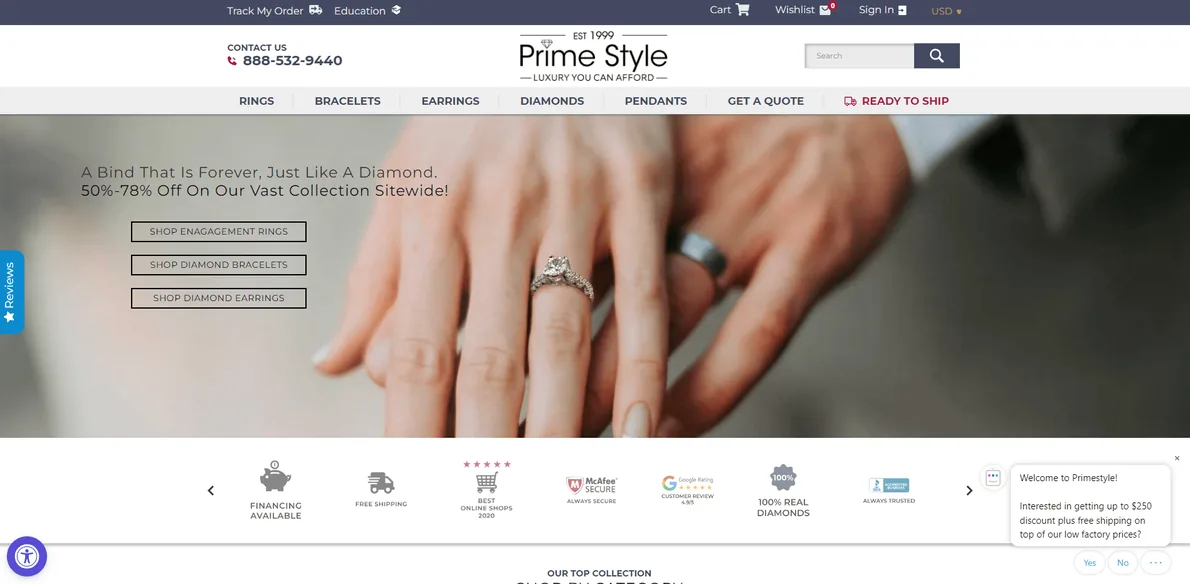
PrimeStyle is a diamond-jewelry manufacturer with its own collections and designs, in the trade since 1999. Their focus is the milestone end of the market: engagement rings, bridal sets, wedding bands and diamond bracelets, at factory prices. In their own words, luxury you can afford.
We did not start here. We were already managing the owner's Google Ads and helping with analytics and reporting, and that is the part that matters: he had seen how we work before he handed us the rest. When he decided it was time to grow sales properly, he gave us the whole funnel.
That is the kind of engagement we are built for. Diligent runs as three departments that work as one, PPC, Web Analytics and Conversion Rate Optimization, and PrimeStyle got all three at once. One team owning the measurement, the traffic and the storefront, instead of three vendors pointing at each other whenever a number moves.
We had a clear order of operations and we stuck to it: get the tracking right first, then drive the right traffic, then fix the place that traffic lands. Over about 18 months we did all of it. The headline is the storefront redesign, a 46% lift in conversion rate, but the redesign only worked because of everything underneath it.
A 20-year brand on an aging site, and an account that leaked.
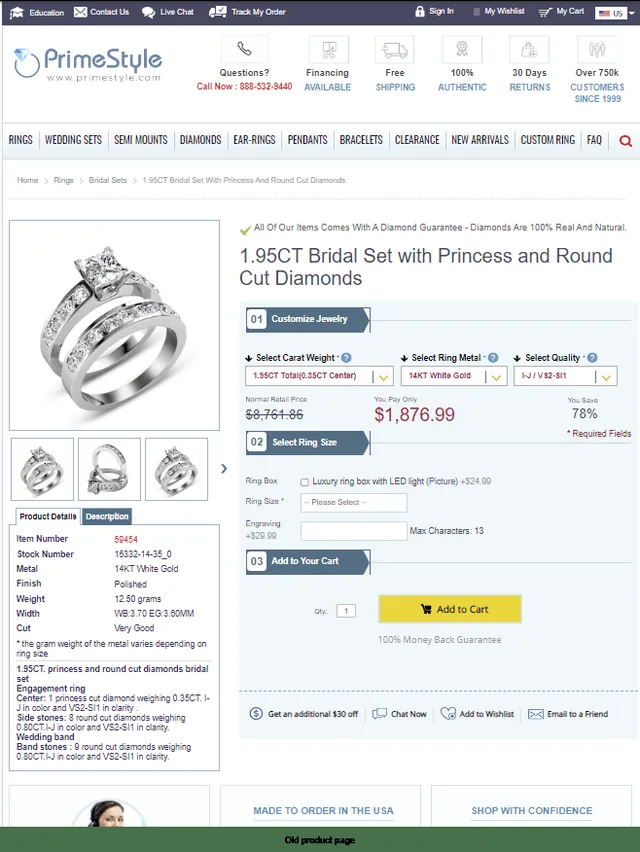
The product was world-class and the brand had two decades of trust behind it. The digital side had not kept up. The storefront was an aging Magento site that no longer matched the quality of the diamonds on it, and the owner knew its weaknesses were costing him sales. He just did not know how to fix them.
Underneath, the ad account told the same story. It had years of history and real scale, but it had grown messy: keywords grouped poorly, wasted spend (the "bleedings") at every level, negative keywords that were not done right, and single campaigns trying to target several continents at once. The tracking had holes too, with one chat tag double-counting and an add-to-cart tag switched off, so the platforms were optimizing on numbers no one fully trusted.
And there was a clock. The owner wanted a modern storefront that still preserved the legacy and the brand he had built, he wanted to move the whole shop off Magento and onto Shopify, and he wanted it live before Black Friday. All at once.
- A modern storefront that preserved a 20-year brand
- A full Magento to Shopify replatform
- Live before the Black Friday peak
- Built on tracking we could finally trust
Measure first, drive the right traffic, then rebuild where it lands.
We ran the engagement in the order that actually compounds: a clean measurement layer first, then a disciplined ad account feeding the funnel, then a Facebook channel alongside it, and only then the big storefront rebuild, watched closely after launch. Each piece made the next one work harder.
a Tracking we could trust
Before touching a campaign, we rebuilt the measurement. Using Google Tag Manager, we defined every micro and macro conversion that mattered and sent each one back to one place: Google Analytics, Google Ads, Bing and Facebook, all from a single source. Then we set up Google Analytics properly, with goals, audiences, custom segments, visual funnels and custom reports, so we could actually see how people moved through the funnel.
We also closed the holes the audit had found. We fixed the chat tag that was double-counting, switched the dormant add-to-cart tag back on, and set one clean primary conversion so the platforms stopped optimizing toward noise. On top of that we ran weekly QA on every tag, reconciled backend revenue against Google Analytics, and sent weekly and monthly reports with the attribution view behind each number.
And we put that data to work, not just collect it. We used Google Analytics the way it is meant to be used: multi-channel funnel reports to see which channels and keywords actually assisted a sale, model-comparison reports to watch how the credit moved under different attribution models, and goal funnels to find exactly where shoppers were dropping out of the checkout. The tracking was the foundation; the analysis on top of it is what turned numbers into decisions.
Every platform optimizing on the same clean, deduplicated conversions, instead of four tools each counting something different.
b We rebuilt the ad account
With the data trustworthy, we tore down the messy account and rebuilt it for granularity. We split brand from non-brand, gave every target country its own campaign instead of stuffing continents into one, and used a tight alpha-beta structure so budget flowed to the search terms that actually convert.
Then we went hunting for waste. We cut the bleedings level by level, across keyword, ad group, device, geography and demographic, and brought real discipline to negative keywords so the account stopped paying for clicks that were never going to buy a diamond. We cleaned up the Shopping feed, ran the account across Google and Bing with a Yandex test on the side, and used a bid-automation script to manage bids at a granularity a human cannot match by hand.
Then we kept it tight with a rhythm of optimization protocols, daily, weekly and monthly: mining the search-term report to add the queries that convert and negative the ones that never will, re-checking every level for fresh bleeding, and re-reading the device, geography and demographic splits as new data landed. An account this size does not stay clean on its own. It stays clean because someone is in it, looking for the next bit of waste.
A granular, waste-trimmed account where the budget chased the searches that convert, not the ones that just spend.
c We opened the social funnel
Search captures people who are already looking. To grow beyond that, we built out Facebook as a second demand channel, run as a proper funnel rather than a single audience. Cold acquisition campaigns introduced the brand, and remarketing campaigns chased the people who had browsed a ring or started a checkout and drifted off.
Because the tracking already fed Facebook the same clean conversions, the platform could optimize toward real purchases from day one, and we mapped audiences and creatives to each stage of the funnel. We tested ad copy and banners continuously, and worked directly with Facebook's own marketing team on the account.
We also tied the platforms together rather than running them in separate silos. Search remarketing lists let us bid differently on Google for people the site and Facebook had already warmed up, so a shopper who browsed a ring and left was met again at every door they came back through. One funnel with several front doors, not three disconnected ad accounts.
Facebook is where it paid off hardest. Once the audiences and the product catalog were dialed in, the strongest campaigns returned between 8x and 12x on ad spend: the seasonal "spring sale" push hit a 12.6x ROAS, and the dynamic-remarketing campaigns ran around 9x to 10x, at click-through rates above 2%. Remarketing to people who had already viewed a ring did the heavy lifting.
Facebook's best campaigns returned 8x to 12x on ad spend, with dynamic remarketing the efficient core.
d We redesigned the whole storefront
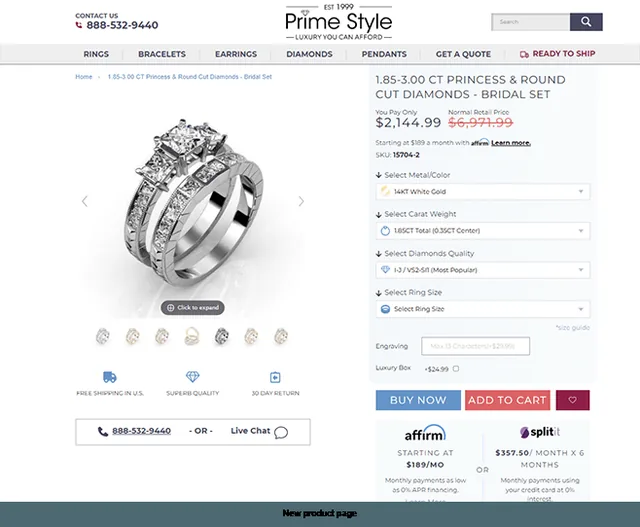
Then the centerpiece. After detailed competitor analysis and a full audit of the existing site, we built a complete redesign strategy that combined jewelry-niche best practice with PrimeStyle's own identity: modern and faster, but unmistakably the brand customers already knew.
We designed low- and high-fidelity mockups for every page that carries the sale: the homepage, the category pages, the product page, the cart and the checkout funnel. Then we replatformed the entire shop from Magento to Shopify, a big move with a lot of moving parts, and timed it to go live before Black Friday.
A replatform can spook loyal customers, so we did not just flip a switch. We ran the New Website Launch and pre-launch email campaigns to warm up the existing list, prepare them for the change and hand them a celebratory discount, so the people who knew the old site arrived ready for the new one.

A modern, faster Shopify storefront that kept everything a 20-year brand had earned.
e Then we watched it like hawks
A change this big always risks a dip. Returning visitors get disoriented, and that can dent conversions before it helps them. The pre-launch emails softened the landing, and then we measured the reception obsessively rather than hoping for the best.
We ran Hotjar session recordings and a launch survey to surface any functionality issue fast, and reported them to the client as they appeared. On the design itself, we added Related-product and Complementary-item sections to give shoppers an easy next step, and kept iterating on what the quantitative and qualitative data told us.
A launch we steered with data, not crossed fingers: issues caught early, the journey deepened page by page.
A storefront that converts, on a funnel that finally fits together.
The redesigned sales funnel brought a 46% lift in conversion rate, measured across five months and compared with the same period the year before. For a brand selling considered, high-value purchases, that is a big move.
Engagement rose with it. Average time on the product page went up 56%, and the Hotjar recordings showed why: shoppers were actually using the new Related-product and Complementary-item sections, moving through the catalogue instead of bouncing.
We did not only trust the analytics, we asked the customers. The launch survey drew 109 responses, and the reaction was decisively positive: more than 70% rated the new site excellent or very good, and 92% reported no issues at all. For a full replatform launched into peak season, that is the result you hope for.
And the redesign did not stand alone. It sat on top of the rebuilt foundation: clean tracking feeding every platform, a granular, waste-trimmed Google and Bing account, and a Facebook funnel alongside it. The new storefront converted traffic we were already paying for more efficiently, which is the point of running the funnel as one system.
The paid side delivered most of all on Facebook. On the clean tracking and the rebuilt account structure, the best-performing Facebook campaigns returned 8x to 12x on ad spend, led by dynamic remarketing and the seasonal pushes, while Google, Bing and Shopping carried the always-on demand. High-value jewelry is seasonal and low-volume, so the real win was a structure that kept finding the efficient pockets and feeding them, not one lucky month.
A storefront, its ads and its analytics are one system.
The reason PrimeStyle's redesign delivered 46% is the same reason a lot of redesigns do not: it was not a standalone project. It launched on top of clean tracking and a disciplined ad account, so a better storefront converted better traffic that we could actually measure. Rebuild the page in isolation and you are guessing; rebuild it on a funnel that fits together and you compound.
So the order matters. Measure first, then drive the right traffic, then optimize the place it lands. And when you modernize a brand with two decades behind it, preserve what it has earned while you change everything around it.
That is what we do for ecommerce brands: run the whole funnel as one, so the tracking, the ads and the storefront make each other work harder instead of fighting for credit.
- Conversion tracking rebuilt in GTM (micro and macro)
- One clean primary conversion, deduplicated across platforms
- Google Ads restructured: granular, brand vs non-brand, per country
- Bleedings cut at every level, real negative-keyword discipline
- Shopping feed optimized; Google and Bing, plus a Yandex test
- Facebook acquisition + remarketing funnel (best campaigns 8-12x ROAS)
- Full storefront redesign: home, category, product, cart, checkout
- Magento to Shopify replatform, live before Black Friday
- Launch and pre-launch email campaigns
- Post-launch Hotjar testing, surveys and iteration