
A different kind of investment, and a different kind of buyer.
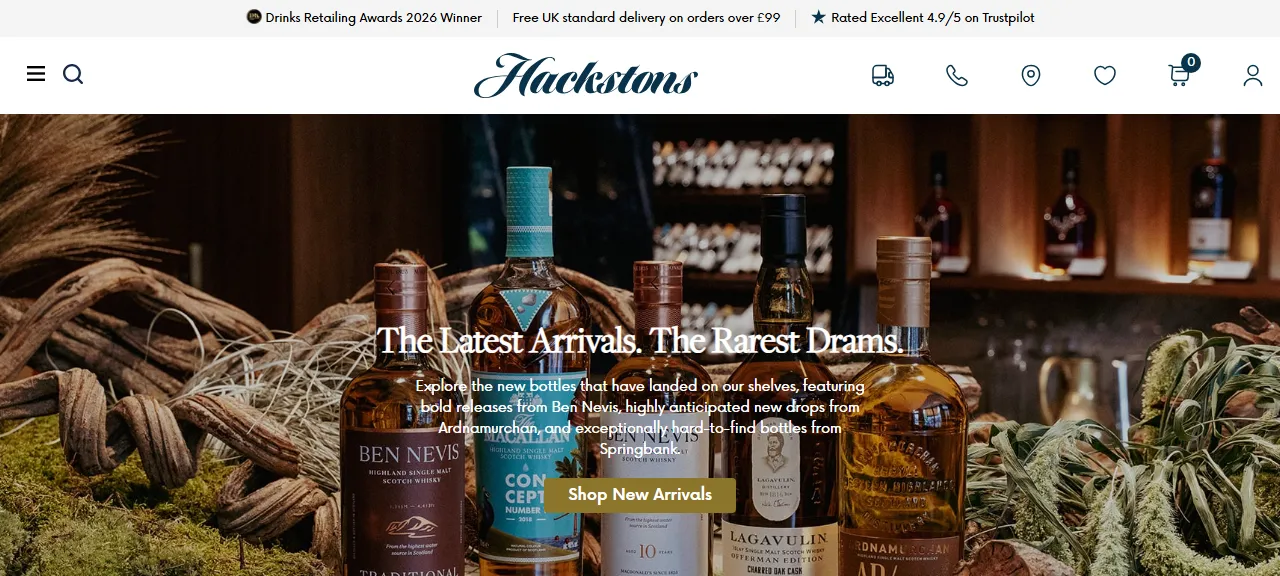
Our client, Hackstons, is a brokerage firm from the United Kingdom, but not the kind that puts your money into stocks or crypto. They deal in tangible assets, the things you can actually hold and store: whisky casks, gold, fine timepieces and classic cars.
From a digital agency's point of view, Hackstons is a lead-generation business. They reached out to us with one clear goal, to generate qualified leads, people genuinely ready to put real money into a cask of maturing whisky or a rare watch. Our job was to optimize the funnel that brings those investors in, and to do it without burning the budget.
The brand had a lot going for it. They are a trusted provider, with HMRC-approved bonded warehouses for cask storage, and a Trustpilot profile most companies would envy. The promise was clearly there. What picked our brain was the niche itself, because selling an alternative investment online is a very different game from selling a regular product.
The platforms themselves were the first obstacle.
It is far harder to run ads for an investment opportunity than for basic ecommerce, and even harder when the asset is whisky. The ad platforms really do not like advertising alcohol, and they like advertising investments even less. Our campaigns kept getting limited or disapproved, simply for being in the category they are in.
So before any clever optimization, the first challenge was just getting the ads to run at all, and to run cleanly. Every disclaimer of unguaranteed success had to be visible, every word checked, no flashy double meanings that create confusion instead of desire. We had a lawyer review the copy before campaigns went live.
On top of that sat the number that mattered most: the cost per lead. When we analysed the old campaigns on Meta, the average cost per lead was well above what the budget could carry, which made marketing-qualified leads far too expensive to scale. We knew there were ways to bring it down, but some of the obstacles were not so easily foreseeable.
And there was the quality question underneath it all. A lead is not a lead if the person never had the means to invest. It was never only about how many leads came in, but about how many of them were real, qualified investors, which is a much harder thing to optimize toward.
Restructure the PPC, build the funnel, qualify the lead.
a Restructuring the Google Ads account
We started where the waste was easiest to find, in the structure of the Google Ads account. We ran fresh keyword research, refined the ad copies, and streamlined the ad groups so every search matched a relevant, tightly written ad, which is the quickest way to lift relevance and bring the cost down.
We added the ad extensions the account was missing and moved bidding toward Max Conversions, which for a lead-generation business is usually the right call once the tracking is honest and the conversions are clean. The goal was simple, maximum visibility for the searches that matter, minimum spend on the ones that do not. This is the kind of disciplined Google Ads management that compounds week after week.
A tighter Google account, built so every pound of spend chased a search that could actually convert.
b A gated guide to separate intent from curiosity
Because this is a lead-oriented funnel, the smartest top-of-funnel move was not a harder sell, it was generosity. Hackstons produced a downloadable guide to tangible-asset investing, free but gated behind a short form, the kind of expert content that informs a real purchase decision.
That single piece did two jobs at once. It positioned the brand as the expert in a field most people do not understand yet, and it acted as the filter that separates the genuinely interested from the merely curious. Someone who downloads a serious guide on cask investment is a very different prospect from someone who clicked an ad by accident.
Informing users and guiding them down the funnel, rather than rushing them, turned out to be one of the best ways we had to keep the leads qualified as the volume grew.
Gated expert content did the quiet work of qualifying a lead before it ever reached the form.
c Fixing the funnel where it leaked
In the second month our CRO team turned to the landing pages, because a high cost per lead is very often a landing-page problem wearing a media-spend mask. The test is a simple one: if traffic to the page is rising but the conversion rate is falling, the leak is on the page, not in the campaign.
So we ran a landing-page audit and asked the uncomfortable questions. Was the form too long? Was the site hard to navigate? Did the user have to click too many times before they could act? Did the page load slowly? Every one of those is a quiet contributor to a high cost per lead.
We gave the client clear recommendations to improve the speed to value on the page, to shorten the path and make the user journey simpler and quicker, with intuitive design and the information in the right order. As we fixed the journey and kept testing, the conversion rate climbed to 13.5%.
The funnel work lifted the conversion rate to 13.5%, so every click had a better chance of becoming a lead.
d Rebuilding Meta around Lead Ads and qualification
Meta was where the cost per lead hurt the most, converting a lead for far more than a downloadable PDF should ever cost. We still wanted to capture leads there, so we rebuilt the approach around Meta Lead Ads, with the qualifying questions asked right on the platform.
The instant forms are the beauty of Lead Ads, especially on mobile, where a few taps hand you a contact already filled in. But the questions are the real trick. By asking for the key information up front, in this case how much someone was ready to invest, we let the form clean out the non-qualifying leads before they ever became a cost.
We also changed how we targeted. Rather than stacking narrow interests, we leaned into broad targeting and let Meta's machine learning find the right people, while running interest-based campaigns alongside it so the two could feed each other. And we put the brand's best asset to work, the genuinely excellent Trustpilot reviews, front and centre in the creative and the copy.
Lead Ads with qualifying questions, broad targeting and Trustpilot proof brought the Meta cost per lead down hard against the old prospecting setup.
e Writing copy that a restricted niche will actually approve
None of this works if the ads do not run, and ours kept getting limited or disapproved for being investment and alcohol promotions. Even with a trusted, HMRC-credentialed client, getting the campaigns to serve smoothly was a fight in itself.
So the copy became a craft of its own. Every disclaimer had to be in place, every claim defensible, every word weighed against both the platform policy and the lawyer's review, all inside the character limits the ad platforms give you. It took seven full rounds of revision to get the campaigns approved and serving.
It was slow, and at times frustrating, but it was the price of entry in this niche. Once the copy was right and the platforms accepted that the website and landing pages were legitimate, the account finally had room to perform.
Seven rounds of careful, lawyer-checked copy were what it took to get a restricted niche approved and serving.
Cost per lead down about 60%, on qualified leads, fast.
The Google Ads side moved first and moved hard. After the restructure, the cost per lead fell about 60% month on month, and by February 2024 the account was converting at the lowest cost per lead it had ever recorded. For a category the platforms keep at arm's length, that was a real breakthrough.
Meta followed the same direction. The rebuilt Lead Ads campaigns, with their qualifying questions and broad targeting, came in far cheaper than the old interest-only prospecting that had been bleeding the budget, and the cost per lead there dropped by more than half against that old setup.
But the number we were proudest of was the quality one. The point of the gated guide and the qualifying questions was to stop paying for leads that were never going to invest, and it worked: through the first quarter of 2024, qualified leads grew about 640%. More leads, far cheaper, and a far higher share of them real.
And the funnel underneath it all held, with the conversion rate up at 13.5% after the CRO work. We ran this hard through the start of 2024 and handed the account over in early March, at the most efficient and best-qualified place it had been.
In a hard niche, patience and qualification beat brute force.
When the platforms fight you, throwing more budget at the problem is the worst thing you can do. The win came from doing the boring work, restructuring the account, rewriting the copy until it cleared policy, and building a funnel that filtered out the wrong people instead of paying for them.
It also came from refusing to treat PPC and CRO as separate jobs. The ads brought people in, the gated content and the landing pages decided who was worth keeping, and the qualifying questions made sure we only paid for the leads that mattered. That is exactly why we run advertising and conversion work as one funnel.
Hackstons is the proof that a difficult, restricted niche is not a dead end. With honest measurement, careful copy and a funnel built to qualify, we cut the cost per lead about 60% and grew the qualified ones many times over, in a category most agencies would not touch.
We know how much rides on getting lead generation right, and we have spent years doing exactly this, across Google Ads, Meta and the conversion work that makes the spend pay, for businesses in niches far harder than they look.
- Google Ads restructure: keyword research, tighter ad groups, Max Conversions
- A gated expert guide that qualifies before the form
- Landing-page and funnel CRO, conversion rate to 13.5%
- Meta Lead Ads with pre-qualifying questions
- Broad targeting that let Meta's machine find investors
- Trustpilot social proof in creative and copy
- Ad copy fine-tuned over 7 rounds to clear policy
- One-month collaborative push that cut CPL up to ~87%