

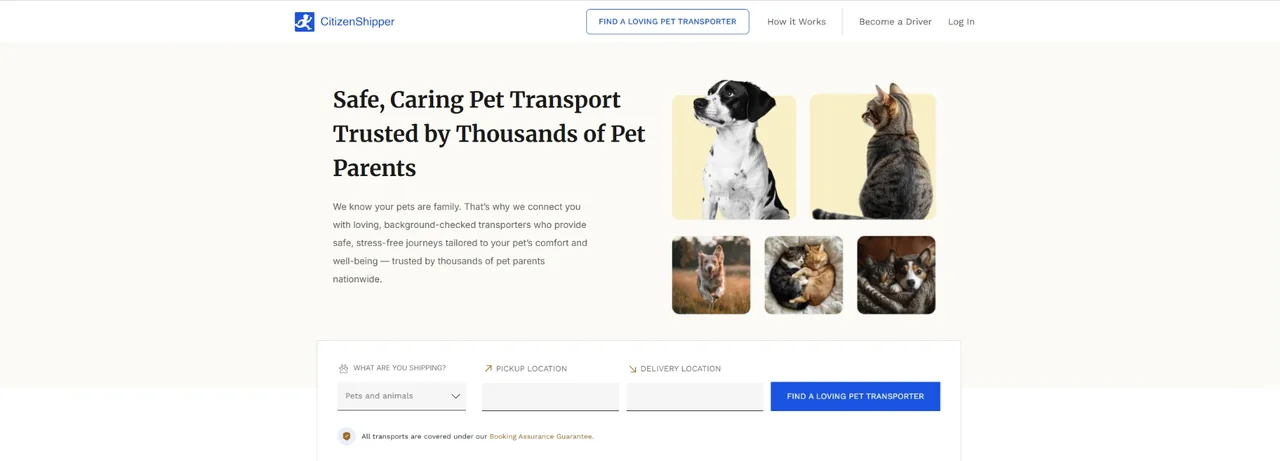
A marketplace with two customers at once.
When CitizenShipper came to us, they had the kind of business most agencies never get to touch: a true two-sided marketplace. Every completed job needs two customers at the same time, a shipper who posts a shipment and a driver who bids to carry it. Get either side wrong and nothing moves.
Pets are the heart of it. Someone shipping a dog across the country is not mailing a parcel, they are trusting a stranger with a member of the family, so the whole experience runs on reassurance: driver ratings, reviews, photos along the way. Their CEO later set the goal out in plain terms, to rebrand CitizenShipper as the pet transportation marketplace and then expand into the categories beyond pets. Around the pets they also moved cars, boats, motorcycles, furniture and freight.
They came to us to do three things at once: bring in more shippers, bring the cost of each one down, and finally measure the whole thing properly, so they actually knew what their ad spend was buying.
Two funnels, and tracking you could not trust.
A two-sided marketplace is two acquisition problems wearing one coat. We had to win more shippers posting jobs, and at the same time keep enough drivers signing up in the right places, because a shipment with no driver to carry it is not a sale, it is a refund.
And the measurement underneath it was not solid. Not every shipment was getting a shipment ID, which sounds small and is actually fatal: if a posted shipment is not tagged, you cannot tie it back to the click that created it, so you cannot tell which channel, campaign or keyword is doing the work. They were spending real money on Google with no honest read on what it returned.
There was a funnel problem too. A listed shipment is only the first step, it still has to convert into a completed, paid job, and that listed-to-completed rate sat at around 13-14%. Scaling listings is pointless if the completion rate slips as you do it.
So before we scaled anything, we had to make the account measurable, then attack both funnels at once. We focused on three things:
- Honest, end-to-end tracking
- Shipper acquisition at a sustainable cost
- Driver acquisition, in the right places
Track it, restructure it, then scale both sides.
We built the measurement first so every later decision ran on real signal, restructured the account to get an immediate win, then spent two years widening it: more categories, more states, more platforms, and the whole second marketplace of drivers.
a Tracking and analytics, first
Before we touched a bid, we fixed the measurement. We rebuilt the conversion tracking through Google Tag Manager, made sure every posted shipment fired a clean event with an ID we could trust, and pushed the data we needed from the dataLayer back into Google Analytics for analysis.
Then we reconciled it across everything. Google Ads, Bing and Facebook each got their own ROI dashboards, all reconciled into one analytics view alongside the platform's own data, so for the first time the client could see 5 platforms in a single honest funnel instead of five numbers that disagreed. We ended up with 26 tracked events across the journey, and we worked alongside the client's own data-science team so our reporting lined up with theirs.
Five platforms reconciled into one funnel, with 26 events tracked, so every decision after this ran on data we trusted.
b The takeover and the restructure
We inherited an account that was thin: a few broad campaigns, a handful of mostly short-tail keywords, and negatives that were not added often enough. Plenty of spend, not enough structure.
So we rebuilt Search around Single Keyword Ad Groups and a clean split between acquisition and converting campaigns, and we added negatives daily to stop the bleed. The point was control: tight ad groups mean tighter ads, higher relevance, and a lower cost per lead.
The first month told the story. Conversions jumped 275% and the cost per acquisition fell 67%, from the restructure alone.
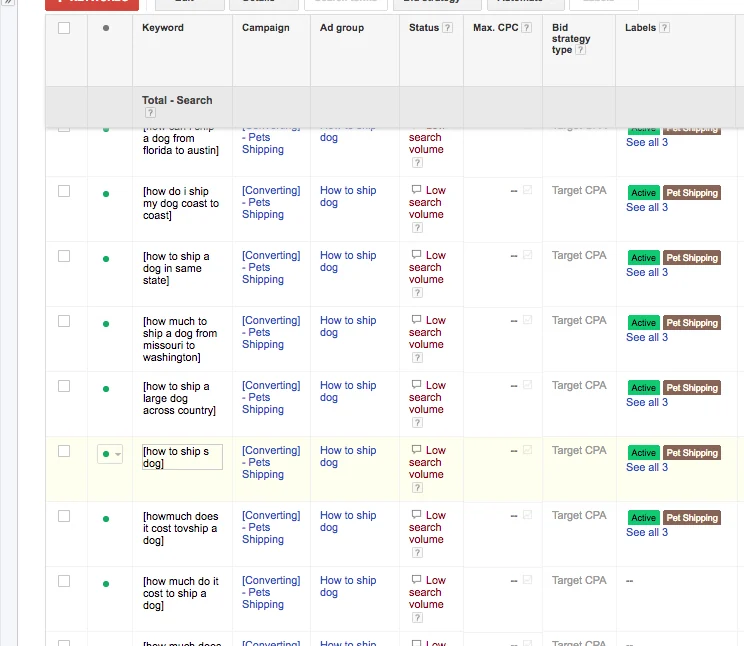
Conversions +275% and cost per acquisition -67% in the first month, from the restructure alone.
c The granular Google Ads engine
With the structure proven, we made it granular. Every category got its own campaigns, dogs, cats, pets in general, boats, pet transporters, because a "dog shipping" searcher and a "boat transport" searcher want completely different things, and a blended campaign hides that.
We went down to the state level too, running dedicated campaigns from Texas and Florida to California, New Jersey and New York, because supply and demand for shipping is regional and a national average lies to you.
Underneath it ran a daily loop: the acquisition campaigns on broader match surfaced new search terms, the ones that converted graduated into exact-match converting campaigns that got the budget, and everything irrelevant flowed into an ever-growing negative list. We kept the keywords that cleared a 50% ROI bar and cut the ones that did not. This is the kind of hands-on Google Ads management that compounds week after week.
On top of that we layered RLSA, Dynamic Search, remarketing per category, and brand. Brand and remarketing were the efficiency engines, returning more than 10x their cost, while broad acquisition ran lean and fed the converting campaigns with fresh terms. That division of labour is what kept the whole account profitable as it grew.
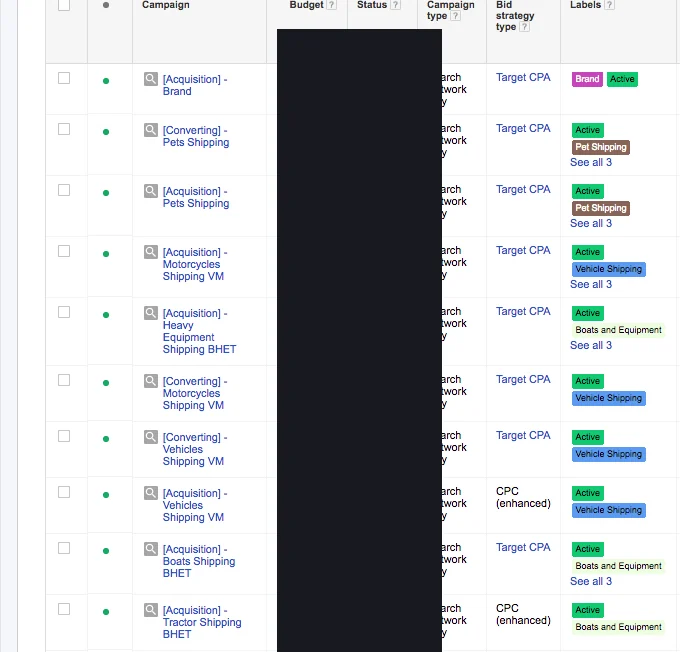
Brand and remarketing returned more than 10x, with budget concentrated on what converted, by category and by state.
d The other side: driver acquisition
Here is the part that makes a marketplace different. None of the shipper demand matters if there is no driver to carry the job, so we ran a whole second acquisition engine for drivers, mostly on Facebook.
We targeted by interest, with transportation and moving audiences doing the heavy lifting, then built 1% lookalike audiences off our most recent driver sign-ups, so Facebook went and found more people like the drivers who had just joined. Retargeting caught the ones who visited the driver pages but did not finish.
It worked, and it was cheap. The driver ads ran at around a 4-5% click-through rate, and we brought in new drivers at scale, at a fraction of what a shipper lead cost us on search. The supply side scaled right alongside the demand side, which is the only way a marketplace actually grows.
New drivers acquired well below the cost of a shipper lead, so supply grew with demand.
e Bing, landing pages and a chatbot
We did not stop at Google and Facebook. Bing ran as a second search platform on the same structure, picking up volume Google could not, at a cost that often beat it.
On the website side we built top-of-funnel landing pages around the questions people actually ask, like how to ship a pet safely, turning blog intent into listed shipments, and we tested them properly. One head-to-head put a winning landing page at about 17.9% conversion against 16.6% for the control, a real lift we then rolled out. We also used multi-step "breadcrumb" lead forms, breaking one long form into small steps so more people finished it.
And we ran a ManyChat chatbot on the Facebook side to catch and qualify people in Messenger, another door into the same funnel.
A measured top of funnel, a winning landing page at about 17.9%, and a second search platform, all feeding the same honest tracking.
f The optimization grind
The grind we love. Every day we checked the account for anything bleeding or broken. Twice a week we mined search terms for negatives and new converters. Every week we compared the numbers on rolling 7, 14 and 30 day windows, at account, campaign, ad group and keyword level, because something can look fine on the surface and be rotting one level down.
We tuned bids by demographic, device and placement, and ran a bid-automation script so the granular work stayed accurate instead of error-prone. None of it looks like much. All of it adds up.
Relentless daily and weekly hygiene, the work that keeps a granular account honest as it scales.
Both sides scaled, on numbers we could finally trust.
It started with the takeover. The restructure alone lifted conversions 275% and cut the cost per acquisition 67% in the first month, and that set the tone for everything after.
From there the proof is in the breadth. We grew it into an engine running across pets, dogs, cats, boats and more, state by state, on three ad platforms, with both shippers and drivers acquired and every channel reconciled into one funnel with its own ROI dashboard. Brand and remarketing returned more than 10x, the driver side came in at a fraction of a shipper lead's cost, and the converting campaigns carried the volume.
The quality held while we scaled. The listed-to-completed rate stayed steady at around 13-14%, so the extra listings were real demand and not a loosened definition, and the landing-page work pushed conversion the right way, with our winning page at about 17.9%.
It is worth saying plainly what made all of it possible: the tracking. Once 5 platforms agreed on one set of numbers, we could move budget toward what actually returned and away from what did not, on both sides of the marketplace, every single week.
The relationship wrapped up in early 2020 as the pandemic arrived and reshaped everyone's priorities. We were still finding new levers when it ended, motorcycles, vehicles, video and discovery campaigns all on the table, which is the good kind of place to leave an account: not out of road, just out of time.

Diligent team is responsive, knowledgeable, have good ideas and are excellent members of a larger team. I know that our PPC marketing is in good hands with them. We've seen huge improvement in terms of our total conversions, sign-ups and ROI has improved a lot!
A marketplace needs both sides, and honest numbers underneath.
The lesson here is the one we trust most. You cannot grow what you cannot measure, and you certainly cannot grow a marketplace by feeding only one side of it.
CitizenShipper worked because we fixed the tracking first, then ran two acquisition engines at once, shippers on search and drivers on social, on a structure granular enough to optimize by category and by state, all reconciled into one honest funnel. The month-one breakout got their attention. The two years of patient, hands-on work across both sides is what actually built the thing.
That is what we do. As an agency we specialize in helping businesses grow online through Google Ads and the analytics and conversion tracking that makes the spend pay, whether you sell to one audience or, like a marketplace, to two at once.
- Conversion tracking rebuilt, shipment IDs fixed
- Five platforms reconciled into one funnel (26 events)
- SKAG plus acquisition and converting Search structure
- Per-category and per-state campaigns
- RLSA, Dynamic Search and remarketing
- Facebook driver acquisition with lookalikes off sign-ups
- Bing as a second search platform
- Top-of-funnel and landing-page A/B testing
- ManyChat chatbot